快速解答: 正确的轴加工顺序是什么?
A common shaft machining sequence is material and blank review → center drilling or datum preparation → rough turning → optional stress relief or heat treatment → semi-finish and finish turning → milling keyways, flats, or grooves → drilling or boring → grinding critical journals → final inspection.
The exact order depends on the material condition, shaft length-to-diameter ratio, heat-treatment requirements, keyway design, 生产数量, and required runout, 直线度, 圆度, 和表面饰面.
For precision shafts, the process should establish stable datum surfaces early, support long or slender sections correctly, leave enough allowance for heat-treatment and grinding distortion, and inspect critical dimensions between high-risk operations.
1. Introduction to Shaft Parts Machining
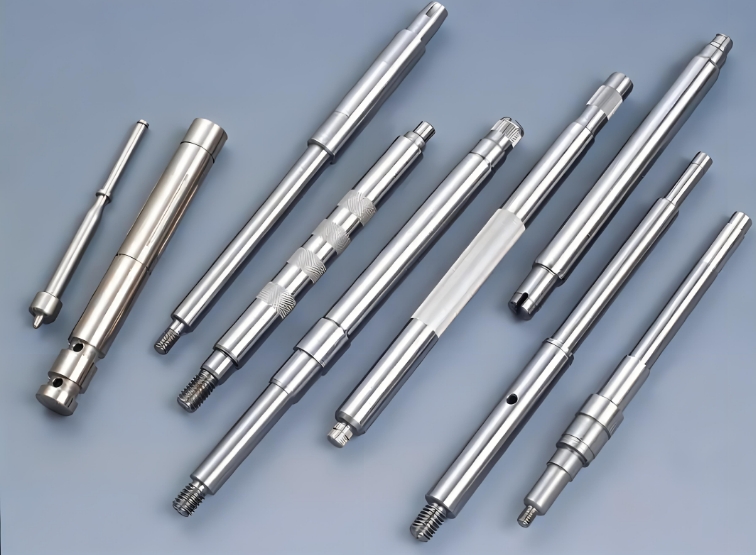
Shaft parts transmit rotation, 扭矩, 运动, or axial load between bearings, 齿轮, couplings, 电机, and other mechanical components.
Unlike a simple cylindrical part, a precision shaft may contain several journals, 肩膀, 线程, 凹槽, keyways, 交叉孔, splines, 轴承座, and sealing surfaces. These features must remain correctly positioned relative to the shaft axis.
The machining sequence therefore affects more than production time. It directly influences runout, concentric feature relationships, 直线度, 圆度, 表面饰面, heat-treatment distortion, and final assembly performance.
Quick Table: Recommended Machining Sequence for Shaft Parts
| 步 | 手术 | Purpose | 工程笔记 |
|---|---|---|---|
| 1 | 绘画, 材料, and blank review | Confirm material, 热处理, stock size, 公差, 和数量 | Material condition and blank form affect machining allowance and distortion |
| 2 | Center drilling and datum preparation | Establish repeatable support and reference surfaces | Center-hole condition is important when machining or grinding between centers |
| 3 | Rough turning | Remove excess stock and create the basic shaft geometry | Leave controlled allowance for heat treatment, finish turning, 和研磨 |
| 4 | Stress relief or heat treatment when required | Obtain the required mechanical properties or reduce residual stress | Recheck straightness, centers, and stock allowance after treatment |
| 5 | Semi-finish and finish turning | Control journal diameters, 肩膀, 线程, and datum surfaces | Do not finish critical grinding surfaces too early |
| 6 | Milling keyways, flats, 凹槽, or splines | Produce functional transmission and positioning features | Timing should consider clamping, 热处理, 失真, and final grinding |
| 7 | 钻孔, 无聊的, or threading | Produce axial holes, 交叉孔, lubrication passages, 和装配特点 | Control hole position relative to the shaft axis and protect finished surfaces |
| 8 | Grinding critical surfaces | Achieve final roundness, 跳动, 直径, 和表面饰面 | Commonly used for bearing seats, 密封面, and precision fits |
| 9 | Surface treatment when required | 提高耐腐蚀性, 戴阻力, 硬度, 或外观 | 定义掩蔽, 涂层厚度, and whether dimensions apply before or after treatment |
| 10 | 最终检查 | Verify functional dimensions, geometric requirements, and treated surfaces | Inspect the shaft in its final delivery condition using methods suited to diameter, 跳动, 直线度, 粗糙度, and coating requirements |
This sequence is a practical starting point rather than a fixed rule for every shaft. Some operations may move earlier or later depending on heat treatment, 工件夹持, 几何学, 及检验要求.

2. Raw Material Selection
The first step in the machining sequence of shaft parts is choosing the appropriate raw material. The material should possess the necessary mechanical properties such as strength, 硬度, 和韧性. Common materials for shaft parts include carbon steel, 合金钢, 和不锈钢. The selection depends on the specific application requirements. 例如, if the shaft is to be used in a high-load and corrosive environment, stainless steel might be a better choice.
The drawing or RFQ should also specify the material condition, 硬度, 热处理, blank form, and certificate requirements.
Common starting blanks include:
- Hot-rolled or cold-drawn bar
- Ground bar
- Forged blanks
- Tubes for hollow shafts
- Pre-hardened alloy steel
- Heat-treated blanks
- Near-net-shape cast or forged components
The blank diameter should provide enough stock for cleanup, straightness correction, heat-treatment movement, and final finishing without creating unnecessary rough-turning time.
For long shafts, incoming bar straightness should also be checked before the machining route is finalized.
3. 转弯操作
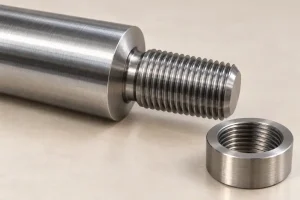
After the material is selected, the turning operation usually comes next. Turning is used to shape the outer diameter of the shaft. It can create a smooth and accurate cylindrical surface. A lathe or CNC turning center is normally used for this operation. The shaft rotates in the spindle while the cutting tool feeds along or across the workpiece to produce cylindrical surfaces, 肩膀, 凹槽, tapers, and threads.During turning, 切割速度, 进给率, and depth of cut need to be carefully controlled. A proper cutting speed ensures efficient material removal and a good surface finish. The feed rate determines the rate at which the cutting tool advances along the shaft, and the depth of cut affects the amount of material removed in each pass.
工程师注意事项: For shaft parts, turning is not only used to create the outer diameter. It also establishes the main datum for later milling, 钻孔, 磨削, 和检查. If rough turning leaves uneven stock or unstable clamping marks, later operations may produce runout, 锥度, or poor concentricity.
Center Holes and Support for Long Shafts
For shafts machined or ground between centers, center holes should be prepared before critical outside diameters are finished.
Center holes provide a repeatable reference and allow the shaft to be supported at both ends. This can be especially important for long or slender shafts that may bend or vibrate under cutting force.
The process review should consider:
- Shaft length-to-diameter ratio
- Center-hole size and condition
- Tailstock pressure
- Chuck clamping length
- Steady-rest or follower-rest position
- Cutting-tool overhang
- 切削力
- Heat-treatment distortion
- Whether the centers will be reused during grinding
Center holes can be damaged by heat treatment, 处理, or repeated setup. They should be inspected and, when necessary, corrected before finish turning or cylindrical grinding.
Long and slender shafts require stable clamping, suitable support, and relatively light cutting tools to limit vibration and deflection. Sandvik specifically notes the importance of rigid clamping and support for slender shaft machining.
4. 铣削操作
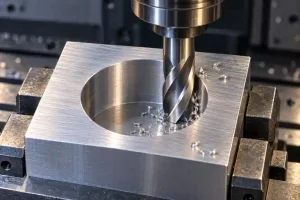
Once the basic cylindrical shape is achieved through turning, milling may be required. Milling is used to create various features on the shaft such as keyways, 凹槽, and flats. The milling machine uses a rotating cutter to remove material. Different types of milling cutters are available for different purposes. 例如, an end mill can be used to create a flat surface, while a slot mill is suitable for making grooves. The orientation and movement of the shaft and the cutter need to be precisely coordinated to obtain the desired shape and dimensions.
When Should Keyways, Flats, and Grooves Be Machined?
Keyways, flats, 凹槽, and splines should normally be machined after the main cylindrical datum has been established.
然而, the exact timing depends on the shaft design.
For many unhardened shafts, these features are produced after rough or semi-finish turning and before final grinding. This allows later grinding to correct small amounts of runout or distortion caused by milling, 夹紧, 或热处理.
Important checks include:
- Keyway position relative to the shaft datum
- Keyway width and depth
- Distance from shoulders and bearing seats
- Cutter access
- Clamping pressure on finished journals
- Burrs at keyway edges
- Heat-treatment distortion
- Whether final grinding will follow
Milling a deep keyway after the critical journals have already been finish-ground can damage finished surfaces or change shaft straightness. When late-stage milling is unavoidable, the workholding and final inspection plan should be defined in advance.
5. Drilling and Boring Operations
Drilling may be used to create axial holes, 交叉孔, lubrication passages, pin holes, 安装孔, or threaded features in shaft parts.
Boring is mainly used when an existing internal hole requires better diameter accuracy, 直线度, 结盟, or surface finish. It is especially relevant for hollow shafts, 袖子, and shafts with precision internal fits.
The machining plan should consider:
- Hole position relative to the shaft axis
- Axial-hole straightness
- Cross-hole breakout
- Drill deflection
- 排屑
- Hole-depth-to-diameter ratio
- Burrs inside intersecting holes
- Thread depth and engagement
- Access for inspection
- Protection of finished journals
Cross holes and pin holes are often produced after the main shaft datum has been established but before final grinding. This reduces the risk of damaging or clamping directly on finished bearing and sealing surfaces.
Deep axial holes may require staged drilling, 专业工具, or additional straightness verification rather than a single conventional drilling operation.
6. 研磨操作
To achieve a very high surface finish and dimensional accuracy, grinding is usually the final step in the machining sequence of shaft parts. The grinding wheel rotates at a high speed and removes a small amount of material from the shaft surface. It can correct any minor imperfections left from the previous operations. Different types of grinding wheels are used depending on the material of the shaft and the desired surface finish. Fine-grit wheels are used for a smoother finish, while coarser-grit wheels can be used for more aggressive material removal in the initial stages of grinding.
工程师注意事项: Grinding should be reserved for critical surfaces such as bearing seats, 密封面, and precision fits. If too little allowance is left after turning, grinding cannot fully correct roundness or runout errors. If too much allowance is left, grinding time and cost will increase significantly.
Heat Treatment and Grinding Allowance
When a shaft requires carburizing, induction hardening, nitriding, through-hardening, or another heat treatment, the machining sequence should account for possible bending, diameter change, center-hole damage, and surface distortion.
Critical bearing seats and sealing surfaces are often left with controlled finishing allowance before heat treatment and then ground to final size afterward.
The required allowance is not a fixed value. It depends on:
- Shaft material
- Heat-treatment process
- Shaft diameter and length
- Journal width
- Expected distortion
- Surface hardness
- Required runout and roundness
- Grinding method
- Final surface finish
Leaving too little allowance may prevent the grinder from removing heat-treatment distortion. Leaving excessive allowance increases grinding time, 热, wheel wear, 和成本.
After heat treatment, shaft straightness, center holes, critical diameters, and surface condition should be checked before final grinding begins.
7. Surface Treatment and Final Protection
Surface treatment should be scheduled according to the shaft’s functional surfaces, dimensional requirements, 和运行环境.
Depending on the application, a shaft may require black oxide, electroless nickel plating, hard chrome plating, 钝化, nitriding, 磷化, or another protective treatment. The selected process can affect diameter, 表面状况, 硬度, 摩擦, 耐腐蚀性, and final fit.
轴承座, 密封面, 线程, center holes, 接地区域, and precision fits may require masking or controlled coating thickness. When coating changes a critical diameter, the drawing should state whether the dimension applies before or after surface treatment.
Final inspection should confirm the required shaft condition after all heat treatment, 磨削, 涂层, 打扫, and handling operations are complete. Critical journals, 跳动, 线程, 表面饰面, and coated dimensions should be checked in the condition required for assembly.
8. 质量控制和检查
Inspection should be performed at suitable stages rather than waiting until every operation is complete.
For precision shaft parts, the inspection plan may include:
- Journal diameter measured with a micrometer
- Runout checked with an indicator while the shaft rotates between centers or in a suitable fixture
- Straightness checked along the shaft axis using an indicator and controlled support
- Roundness or cylindricity checked with suitable form-measurement equipment when required
- Keyway width, 深度, and position checked against the shaft datum
- Thread size checked with thread gauges
- Axial and cross-hole position checked with suitable gauges, optical equipment, or CMM
- Surface roughness checked on bearing, 密封, or sliding surfaces
- Hardness and case depth checked when required after heat treatment
A CMM can be useful for hole locations, 肩膀, feature relationships, and complex geometry, but it is not automatically the best tool for every shaft requirement. 千分尺, indicators, roundness instruments, and surface-roughness testers may provide more direct results for journals, 跳动, 圆度, 并完成.
For parts with complex positional or datum requirements, 回顾我们的 CNC 加工零件 CMM 检验指南.
9. Why the Shaft Machining Sequence Matters
An incorrect operation order may leave the supplier without a stable datum, enough finishing allowance, or a practical way to correct distortion.
| Sequence Problem | 可能的结果 | Better Process Control |
|---|---|---|
| Finish machining before heat treatment | Diameter movement, 弯曲, and lost tolerance after hardening | Leave controlled stock for post-treatment finishing or grinding |
| Milling a deep keyway after final journal grinding | Surface damage, clamping marks, or shaft distortion | Machine keyways earlier when practical and verify runout afterward |
| No stable centers or datum surfaces | Runout and feature-position errors between setups | Establish and protect repeatable reference surfaces |
| Uneven rough-turning stock | Variable cutting load, 锥度, and distortion during finishing | Balance material removal and leave consistent allowance |
| Drilling cross holes after cosmetic or precision finishing | 毛刺, 划痕, and damage to completed surfaces | Plan drilling before final grinding or finishing when possible |
| Too little grinding allowance | Heat-treatment distortion cannot be fully removed | Coordinate turning, 热处理, and grinding allowance |
| Tight dimensions inspected only at the end | Scrap discovered after several expensive operations | Add in-process checks after high-risk operations |
Sequence errors may also accumulate across shoulders, journals, 孔, keyways, and mating parts.
For assemblies with several dependent dimensions, 我们的 CNC machining tolerance stack-up guide explains how small individual errors can become fit or assembly problems.
10. How Rapid Efficient Controls Shaft Parts Machining Quality
Shaft parts often require stable diameter accuracy, 同心度, 直线度, 表面饰面, and reliable fit with bearings, 齿轮, couplings, or sealing components. RapidEfficient supports shaft part machining by reviewing drawings, selecting suitable machining strategies, controlling datum surfaces, and inspecting critical dimensions before shipment.
Datum and Clamping Control
For long or slender shaft parts, improper clamping can cause bending, 振动, or runout. Our engineers evaluate the shaft length, diameter ratio, 临界面, and tolerance requirements before choosing the machining and clamping strategy.
车削, 铣削, and Grinding Coordination
A stable machining sequence helps reduce rework and scrap. Rough turning removes stock, finish turning improves dimensional accuracy, milling creates functional features, and grinding is used for critical surfaces that require better roundness, 表面饰面, or tight tolerance.
Inspection Before Shipment
Before delivery, shaft parts can be checked for key dimensions such as diameter, 同心度, 跳动, 直线度, 孔位置, 螺纹质量, 和表面粗糙度. This helps reduce assembly problems and improves consistency from prototype to production.
常问问题: 轴类零件加工顺序
What is the typical machining sequence for shaft parts?
The typical sequence is raw material selection, 粗车削, finish turning, milling keyways or grooves, drilling and boring, grinding critical surfaces, 和最终检验.
Why is turning usually done before milling on shaft parts?
Turning creates the main cylindrical datum and controls the outer diameter. After this datum is stable, milling operations such as keyways, flats, and grooves can be positioned more accurately.
Why Are Center Holes Important for Precision Shafts?
Center holes provide repeatable support and reference points when a shaft is turned or ground between centers. They are especially useful for long shafts and parts that must maintain consistent runout across several journals.
The center holes must remain clean and undamaged. 热处理, 处理, or repeated setup may require them to be inspected or corrected before final grinding.
When should grinding be used in shaft machining?
Grinding is usually used near the final stage for bearing seats, 密封面, and precision fits that require tight tolerance, good roundness, low runout, or fine surface finish.
Should a Keyway Be Machined Before or After Grinding?
In many shaft processes, the keyway is machined after the cylindrical datum is established but before final grinding. This allows final grinding to correct small changes caused by milling, 夹紧, 或热处理.
The correct timing depends on the shaft material, keyway depth, 热处理, 工件夹持, and runout requirements.
What defects happen if the machining sequence is wrong?
Incorrect sequencing can cause runout, poor concentricity, 尺寸漂移, 刀具过度磨损, 表面光洁度差, 以及组装失败.
11. 结论
The shaft machining sequence directly affects diameter accuracy, 直线度, 跳动, 圆度, 表面饰面, heat-treatment correction, and assembly performance.
A practical sequence usually begins with drawing and material review, center or datum preparation, and rough turning. It may then include stress relief or heat treatment, semi-finish and finish turning, milling keyways or flats, drilling or boring, grinding critical journals, 和最终检验.
The exact sequence should be adjusted to the shaft geometry, length-to-diameter ratio, 物质条件, 热处理, 夹紧方式, 生产数量, and functional tolerances.
For precision shafts, the most important controls are:
- Establishing stable datum and center references
- Supporting long or slender sections correctly
- Leaving suitable allowance for later operations
- Timing keyway and hole machining carefully
- Protecting finished bearing and sealing surfaces
- Checking runout and straightness between high-risk stages
- Using the correct measurement method for each requirement
Review Your CNC Shaft Part
Rapid Efficient can review your shaft drawing, 材料, 热处理, center and datum strategy, journal tolerances, keyways, 线程, 孔, grinding requirements, 表面饰面, and inspection points before quotation.
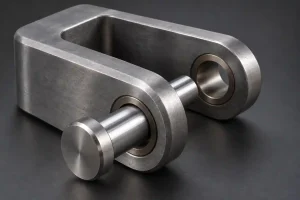
For custom shafts, 袖子, 针脚, 衬套, 螺纹组件, and rotational parts, 回顾我们的 数控车削服务.