
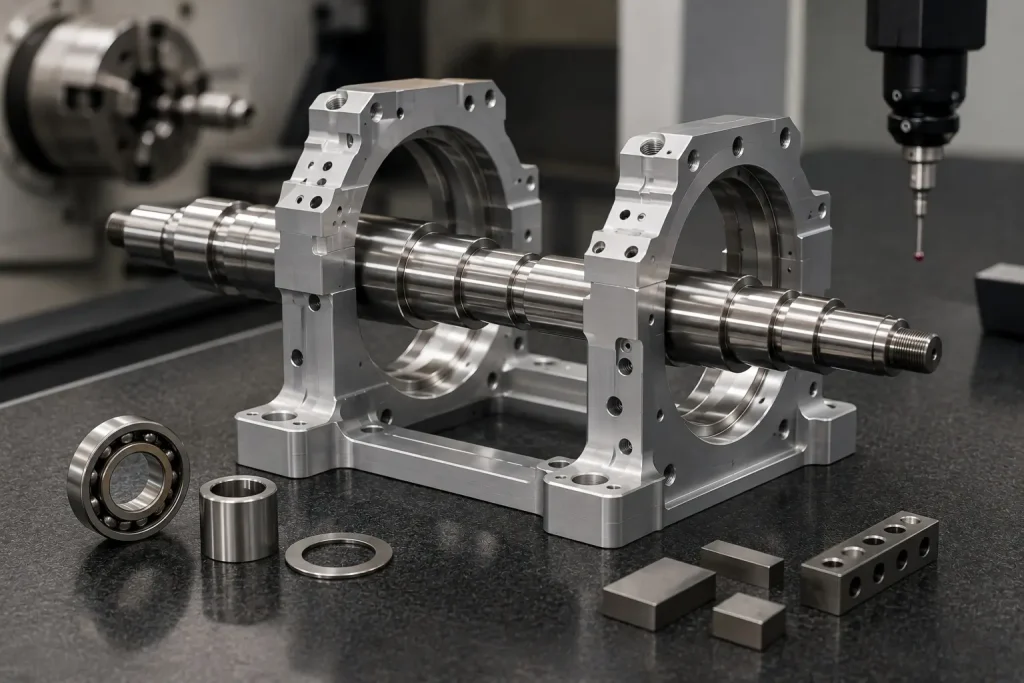
同心度通常用于描述两个或多个圆形或圆柱形特征共享相同中心或轴线的程度.
典型例子包括:
- 轴及其轴承轴颈
- 电机外壳中的前轴承孔和后轴承孔
- 车削部件上的多个直径
- 孔径和外径
- 主轴及其安装面
- 泵组件的密封直径
- 齿轮, 滑轮, 和耦合接口
然而, 这个词 同心度 在日常工程讨论中可能有不同的含义, 遗留GD&T 图纸, 检查报告, 和供应商沟通.
一张简单地说“保持这些特征同心”的绘图是不完整的,除非它还定义了:
- 数据
- 受控特征
- 适用的绘图标准
- 公差类型
- 公差值
- 检查方法
- 检验零件的条件
快速解答
在实际数控加工中, 同心度通常意味着重要的圆形特征应保持以公共功能轴为中心.
但在较旧的 ASME GD 下&练习, 同心度 有更具体的含义: 它控制特征相对于基准轴的导出中点.
同心度符号已从 ASME Y14.5-2018 中删除. 新图纸常用:
- 位置 当孔的导出轴, 轴, 或其他尺寸特征必须相对于基准定位.
- 圆跳动 当旋转过程中各个圆形截面的表面变化很重要时.
- 总跳动 当必须沿其长度控制整个旋转表面时.
- 配置文件或其他控件 当功能需求涉及更复杂的表面关系时.
旧工程图可能仍包含同心度标注. 不要默默地重新解释它. 确认图纸标准, 设计意图, 日期轴, 检查方法, 报价或生产前的验收规则.
通俗工程语言中的同心度
在普通的商店和设计讨论中, 工程师可以使用同心度来描述诸如:
- 两个孔应共用一个轴
- 以内孔为中心的车削外径
- 多个轴颈相互对齐
- 齿轮安装直径与轴承轴颈对齐
- 外壳孔相对于先导直径居中
这种语言传达了一般功能目标, 但它并没有定义完整的GD&T要求.
例如, 短语:
前后轴承孔必须同心.
不告诉厂家:
- 哪个孔确定基准轴
- 要求是否适用于特征轴或实际表面
- 是否包含表单错误
- 检查时是否应旋转零件
- 公差带是否为直径
- 是否在夹紧或释放状态下检查孔
受控绘图应将功能目标转化为可测量的要求.
ASME 传统同心度的含义
在旧版 ASME 图纸上, 同心度并不是简单地比较两个拟合的圆柱轴.
该控制相关 导出的中点 直径相对的表面元素与以基准轴为中心的圆柱形公差带.
这使得真正的同心度难以检查,因为测量过程必须通过多个横截面评估多个相对的表面点.
它不等于:
- 用千分表检查一个直径
- 比较两个拟合圆心
- 从少量 CMM 点测量一根轴
- 仅检查最大和最小孔径
- 测量总指示跳动
由于这个原因, 审查遗留图纸的设计人员应首先确定原始标注旨在防止哪些功能问题.
同心度, 同轴度, 位置, 和跳动
这些术语是相关的, 但它们不可互换.
| 学期 | 它通常控制或描述什么 | 典型用途 |
|---|---|---|
| 同心度 | 在旧版 ASME 图纸上, 特征相对于基准轴的导出中点 | 旧图纸或特殊的批量分发要求 |
| 同轴度 | 多个圆柱特征共享一个轴的功能描述 | 工程通讯; 需要定义的绘图控件 |
| 位置 | 导出轴相对于基准和基本尺寸的位置和方向 | 轴承孔, 轴特征, 孔图案, 适配接口 |
| 圆跳动 | 当零件绕基准轴旋转时,一个圆形截面的表面变化 | 期刊, 密封直径, 轴承表面 |
| 总跳动 | 当零件旋转且指示器沿其长度移动时,整个受控表面上的表面变化 | 长日记, 主轴表面, 精密旋转直径 |
| 圆柱度 | 不参考基准的圆柱面的形状 | 控制圆度, 直线度, 及整体圆筒形式 |
| 圆 | 不参考基准的每个单独圆形截面的形状 | 孔的圆度, 期刊, 和车削直径 |
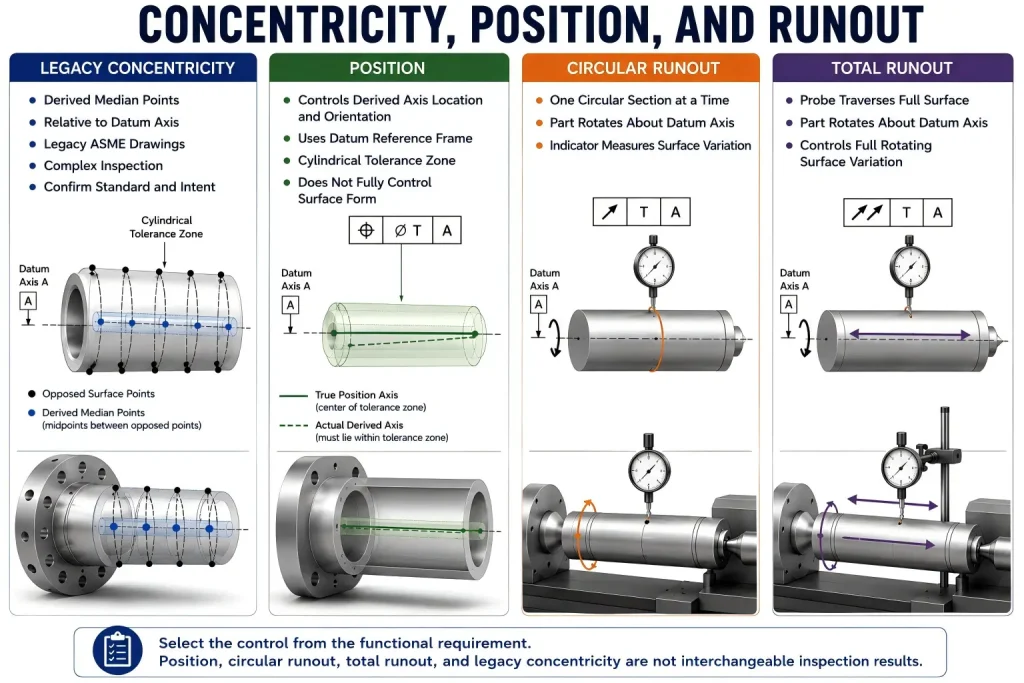
正确的控制取决于装配的实际需要.
位置与同心度
当功能要求较高时,职位通常是更实际的选择:
保持该孔或轴的轴线相对于基准系统正确定位.
职位可能适合:
- 前后轴承孔
- 从基准轴颈开始的轴直径
- 根据安装基准定位的精密孔
- 与装配坐标系相关的孔或圆柱特征
- 其轴必须与功能基准结构对齐的多个特征
位置控制导出轴而不是整个旋转表面.
一个功能可以满足其位置要求,并且仍然具有:
- 圆度误差
- 锥度
- 桶形
- 表面波纹度
- 局部损坏
- 跳动过大
因此,绘图可能需要单独的尺寸, 形式, 当这些条件影响功能时或跳动控制.
For broader tolerance planning, 回顾我们的 CNC加工公差指南.
圆跳动与同心度
圆跳动评估零件绕基准轴旋转时单个圆形截面的表面变化.
通常用指示器或合适的形状测量设备来检查.
圆跳动可以响应综合效应,例如:
- 测量部分的中心误差
- 局部圆度误差
- 表面不平整
- 相对于基准轴的定向误差
与传统同心度相比,它通常与实际旋转接触关系更密切.
可能的应用包括:
- 轴承轴颈
- 密封直径
- 滑轮安装面
- 轴肩
- 精准飞行员
- 齿轮安装直径
千分表跳动读数不应自动报告为传统 GD&T同心度. 它们是不同的控制并使用不同的评估方法.
总跳动与同心度
当测量探头沿该表面移动时,总跳动评估整个受控旋转表面的变化.
它可能会对综合效应做出反应,包括:
- 轴不对中
- 圆度误差
- 表面直线度误差
- 锥度
- 桶形或沙漏形
- 局部表面变化
- 相对于基准轴的方向
总跳动可用于:
- 长轴承轴颈
- 主轴表面
- 精密轴径
- 辊面
- 旋转密封接口
- 沿一个直径的多个功能区域
它通常是比仅检查一个圆形截面更强的表面控制.
同轴度是一个功能目标, 不是完整的绘图说明
工程师经常使用 同轴度 描述应共享一个轴的两个或多个圆柱形特征.
这个描述很有用, 但图纸仍需要说明如何控制需求.
取决于功能, 设计师可以选择:
- 位置
- 圆跳动
- 总跳动
- 尺寸组合, 位置, 和表单控件
- 另一个适用标准下的客户特定要求
- 功能性装配或测量方法
只写:
同轴内 0.01 毫米
可能会产生分歧,因为它没有澄清:
- 直径或径向偏差
- 轴拟合方法
- 表面取样
- 基准建立
- 特征长度
- 检验设备
- 是否包含表单错误
如何选择正确的控制
使用零件功能而不是单独使用术语.
| 功能需求 | 控制审查 |
|---|---|
| 相对于安装基准定位孔轴 | 位置 |
| 相对于基准轴颈定位一个轴直径 | 位置或跳动, 取决于功能 |
| 限制一个旋转部分的表面变化 | 圆跳动 |
| 限制整个旋转表面的变化 | 总跳动 |
| 无基准控制气缸形状 | 圆柱度 |
| 控制单个圆形截面形状 | 圆 |
| 保护等质量或传统派生中点要求 | 查看旧的同心度定义 |
| 验证实际装配旋转 | 跳动或功能测试可能更相关 |
| 对齐几个分离的孔 | 位置, 跳动, 或特定于项目的同轴检查计划 |
设计团队, 制造商, 在生产开始前,检验小组应就相同的解释达成一致.
为什么共享轴精度很重要
旋转或配合特征之间的对齐不良可能会导致:
- 轴承预载变化
- 轴承负载不均匀
- 轴摆动
- 振动
- 噪音
- 密封磨损
- 泄漏
- 齿轮接触不均匀
- 联轴器不对中
- 增加摩擦力
- 部件寿命缩短
- 组装难度
严重程度取决于:
- 转速
- 加载
- 轴承布置
- 轴长
- 特征直径
- 清除
- 密封设计
- 材料刚度
- 润滑
- 工作温度
- 组装方法
慢速手动机构和高速主轴不应自动接收相同的轴控制要求.
具有共享轴要求的常见 CNC 零件
电机外壳
前轴承孔和后轴承孔可能需要受控关系,以减少轴承不对中和转子干涉.
轴
轴承轴颈, 密封直径, 线程, 肩膀, 并且耦合特征可能需要保持与功能基准轴的相关性.
齿轮和滑轮部件
齿轮齿或皮带表面可能需要相对于孔或安装导向件一致旋转.
泵和阀门组件
博雷斯, 密封直径, 轴通道, 和旋转接口可能需要受控对齐.
精密衬套
内径和外径可能需要稳定的关系以进行装配和壁厚控制.
主轴
长旋转表面可能需要尺寸, 形式, 跳动, 表面饰面, 和热稳定性要求,而不是一般的“同心度”注释.
轴承架和齿轮箱
单独的孔可能需要相对于公共基准结构和装配接口对齐.
不存在普遍的“同心度好”值
固定的桌子,例如:
- 通用部分: 0.05 毫米
- 精密零件: 0.02 毫米
- 高速部分: 0.01 毫米
- 超精密零件: 0.005 毫米
不应用作通用设计规则.
适当的要求取决于:
- 特征直径
- 特征长度
- 转速
- 轴承游隙
- 加载
- 密封设计
- 噪声目标
- 装配堆叠
- 基准质量
- 材料
- 壁厚
- 表面光洁度
- 热处理
- 涂层
- 检查方法
- 测量不确定度
- 生产数量
容差值还需要正确的上下文.
例如:
- 位置公差可以定义直径圆柱区域.
- 指示器可以报告总指示跳动.
- CMM 可能会根据程序报告径向或直径偏差.
- 客户报告可能使用轴偏移或最大中心位移.
在定义一致之前不应比较这些数字.
CNC 加工如何控制共享轴
1. 从功能数据开始
最重要的轴并不总是最容易夹紧的表面.
数据应代表装配体的功能关系.
可能的基准特征包括:
- 轴承轴颈
- 精密孔
- 安装飞行员
- 安装外径
- 面和孔的组合
- 一组合格的安装表面
不良的基准选择可能会创建一个在加工设置中测量正确但在实际装配中失败的零件.
对于初级的更深入的解释, 中学, 和三级参考文献, 审查 CNC加工基准的类型.
2. 一次合格设置中的机器相关功能
在不拆卸零件的情况下加工关键直径或孔可以减少数据传输误差.
例子包括:
- 在一次装夹中车削多个轴颈
- 从一个可触及的方向对前部和后部特征进行钻孔
- 在一次装夹中精加工外径和内孔
- 从同一基准结构加工导向座和轴承座
一种设置并不能自动保证良好的对齐.
结果还是取决于:
- 机床主轴状况
- 刀具跳动
- 卡盘或夹头状况
- 夹具刚性
- 切削力
- 热行为
- 刀具偏转
- 零件几何形状
- 物质运动
3. 控制卡盘, 夹头, 和软爪跳动
车削零件可能会继承错误:
- 卡盘爪磨损
- 夹头损坏
- 接触面脏污
- 不正确的软爪镗削
- 下巴压力过大
- 部分座位较差
- 夹持长度短
- 零件变形
- 在不合格的表面上重新夹紧
对于关键的车削特征, 设置可能需要:
- 无聊的软下巴
- 合格的夹头
- 控制夹持长度
- 定义的夹紧压力
- 加载后的指标检查
- 牺牲性加工特征
- 根据功能数据进行最终设置
更多车削特定注意事项, 审查 数控车削件.
4. 规划镗孔和精加工顺序
孔对准可能会受到以下因素的影响:
- 镗杆悬伸
- 刀具偏转
- 断续切割
- 深孔接入
- 排屑
- 库存不均
- 刀具磨损
- 热
- 薄壁
- 精加工余量不一致
可能的流程决策包括:
- 粗镗然后精镗
- 受控库存津贴
- 更短、更坚固的镗刀
- 功能基准的精加工路径
- 刀具磨损监测
- 过程中测量
- 专用整理装置
- 零件稳定后重新检查
正确的路线取决于孔的长度, 直径, 材料, 几何学, and drawing requirement.
5. 在设置传输期间保护数据
有些部分无法一次完成.
当零件被重新夹紧时, 第二个设置应该从保留所需功能关系的合格特征中定位.
设置-转移风险包括:
- 定位面上有切屑
- 毛刺
- 定位器磨损
- 零点偏移不正确
- 夹具移动
- 零件倾斜
- 夹紧顺序不一致
- 基准特征太短或不稳定
- 使用粗糙表面作为最终参考
- 从非功能直径反转零件
设置计划应说明:
- 哪个特征建立了新的轴
- 哪个面控制轴向位置
- 如何限制旋转
- 如何建立零点偏移
- 完成前如何检查设置
- 转移后将检查哪些功能
6. 控制薄壁变形
薄壁外壳在夹紧时看起来是对齐的,并且在释放后会移动.
夹紧力过大可能会导致:
- 孔椭圆度
- 轴移
- 锥度
- 局部变形
- 脸部扭曲
- 松开后跳动
该过程可能需要:
- 更大的接触面积
- 较低的受控锁模力
- 专用固定装置
- 平衡材料去除
- 粗加工和精加工阶段
- 休息或稳定时间
- 放行状态下的检查
- 当功能需要时定义的限制条件
图纸和检验计划应明确验收适用于自由状态还是约定的约束条件.
7. 管理物料移动
去除大量材料可以释放残余应力.
风险较高的是:
- 薄壁外壳
- 长轴
- 大量袋装零件
- 不对称组件
- 焊接毛坯
- 热处理材料
- 库存不均匀的零件
- 具有中断部分的组件
合适的过程可以包括:
- 检查库存形式和材料状况
- 平衡粗加工
- 控制精加工余量
- 多个加工阶段
- 数据重新鉴定
- 最终检查前稳定
- 需要时进行后处理检查
8. 控制工具和机器条件
共享轴特征可能会受到以下因素的影响:
- 主轴状况
- 刀架跳动
- 镗刀偏转
- 尾座对准
- 活中心状态
- 炮塔对准
- 机器预热
- 温度变化
- 探头校准
- 刀具磨损
- 切削条件不稳定
机器性能应与完整的设置和测量过程一起评估.
高规格机器无法补偿不稳定的数据, 扭曲的部分, 损坏的夹具, 或检查对准不正确.
9. 回顾表面处理和热处理
阳极氧化, 电镀, 涂层, 热处理, 缓解压力可能会影响:
- 特征尺寸
- 适合
- 表面状况
- 失真
- 最终跳动
- 测量重复性
关键要求应明确它们是否适用:
- 完成前
- 完成后
- 在遮蔽表面上
- 热处理后
- 打磨后
- 在最终交付状态下
轴承座可能需要进行后处理检查, 密封直径, 精密孔, 期刊, 和其他旋转接口.
如何测量同心度或同轴对准度?
检验方法必须符合图纸要求.
没有一种仪器能够最适合所有功能.
千分表
千分表通常用于评估零件绕既定基准轴旋转时的跳动.
它对于:
- 轴颈
- 飞行员
- 密封面
- 轴承直径
- 端面跳动
- 设置验证
- 快速生产检查
千分表直接测量接触点处的表面运动.
它不会自动评估传统导出的中点同心度.
结果也可能受到以下因素的影响:
- 基准设置
- 夹具跳动
- 中心状态
- 表面粗糙度
- 探头位置
- 零件旋转
- 污垢或毛刺
- 操作技术
三坐标测量机
CMM 可以测量特征并将其与基于基准的零件坐标系关联起来.
取决于图纸和测量计划, 它可能会评估:
- 特征位置
- 孔或轴轴线
- 基准关系
- 多个分离孔
- 型材
- 垂直度
- 选定的跳动要求
- 定义适当的评估方法时的遗留要求
CMM 结果取决于:
- 日期对齐
- 测量点数量及分布
- 特征长度
- 探头接入
- 拟合算法
- 过滤
- 零件温度
- 夹具状态
- 测量不确定度
- 软件评估方法
CMM 报告应确定实际评估的特征.
如需详细的检查计划指南, 审查 CNC 加工零件的 CMM 检测.
圆度和圆柱度测量设备
形状测量机可用于详细评估旋转几何形状.
取决于设备和设置, 它可以评估:
- 圆
- 圆柱度
- 同轴关系
- 圆跳动
- 总跳动
- 锥度
- 沿旋转特征的表面形状
这种方法可以提供比简单的单点指示器检查更详细的旋转形状数据.
基准设定, 定心, 调平, 探测路径, 过滤, 评价标准仍需把控.
孔径计
孔规对于检查很有用:
- 孔径
- 锥度
- 贝尔茅斯
- 桶形
- 选定部分的椭圆度
- 沿孔尺寸变化
单独的孔规通常不能证明两个独立的孔共享相同的基准轴.
它应该与另一个对齐方式结合起来, 夹具, CMM, 跳动, 或当轴关系重要时的功能检查方法.
功能测量或装配测试
当真正的需求是时,功能量表可能会很有用:
- 轴必须穿过两个对齐的孔
- 轴承必须无约束地组装
- 飞行员必须安装配合组件
- 密封件运行时必须没有过度运动
- 齿轮或滑轮必须在约定的限度内旋转
功能检查可能很有价值, 但他们不应该默默地取代绘图要求.
仪表设计, 磨损极限, 验收方式, 与尺寸检验的相关性应事先约定.
检查方法比较
| 检查方法 | 有用于 | 不会自动证明 |
|---|---|---|
| 千分表 | 圆形或端面跳动, 设置检查, 旋转面变化 | 传统导出的中点同心度 |
| CMM | 基准相关轴, 位置, 多特征关系, 记录报告 | 无需正确对准即可获得可靠的结果, 采样, 和评价 |
| 圆度机 | 圆, 圆柱度, 旋转形式, 详细的跳动评估 | 没有正确数据和设置的装配功能 |
| 内径规 | 缸径, 锥度, 椭圆度, 局部尺寸变化 | 分离孔之间共用轴 |
| 千分尺 | 轴直径和局部尺寸 | 轴对齐或跳动 |
| 功能量表 | 与装配相关的通过/失败行为 | 失败的原因还是每个GD&T特性 |
常见绘图错误
一切皆同心
不同的功能可能需要位置, 圆跳动, 总跳动, 圆柱度, 或控件的组合.
缺少基准参考
共享轴要求需要明确的参考.
使用固定的“良好”公差
所需的值应该来自函数, 不是通用公差表.
令人困惑的直径和径向值
径向位置区域, 径向轴偏移, 和总指示器读数不会自动等效.
忽略特征长度
短孔和长孔可能会产生截然不同的轴评估结果.
将要求应用于错误的功能
图纸可以控制非功能性外径,而轴承孔实际上决定装配性能.
忽略表面形状
轴可能定位良好,但表面仍具有过大的圆度, 锥度, 或圆柱度误差.
未能定义最终条件
热处理, 阳极氧化, 电镀, 磨削, 装配预载, 或夹紧可能会改变交付的结果.
常见的制造和检验错误
- 从不合格的表面重新夹紧
- 使用肮脏或损坏的软钳口
- 锁模压力过大
- 忽略薄壁回弹
- 在其他地方进行重型粗加工之前精加工一个关键孔
- 使用过大的镗杆悬伸量
- 未能检查刀具或主轴跳动
- 将内径尺寸结果视为同轴对准的证据
- 将千分表跳动报告为 GD&T同心度
- 使用错误的数据进行测量
- 使用的 CMM 点太少
- 使用不同的对齐方法比较供应商和客户报告
- 竣工后施图时竣工前检查
- 忽略接近公差极限的测量不确定度
共享轴 CNC 零件的询价清单
报价前请提供以下信息:
- 3CAD模型
- 受控二维绘图
- 适用的图纸标准和修订
- 材质等级
- 回火或硬度条件
- 数量
- 功能基准特征
- 受控孔径和直径
- 特征长度
- 位置或跳动标注
- 尺寸和合身要求
- 轴承信息
- 配合轴或外壳
- 转速
- 加载
- 密封要求
- 表面粗糙度要求
- 薄壁区域
- 热处理
- 表面处理或涂层
- 遮蔽区域
- 检查方法
- 抽样或 100% 检验要求
- CMM-报告要求
- 功能规格要求
- 最终检验条件
- 包装要求
对于包含同心度的旧工程图, 还澄清:
- 适用哪个 ASME 或 ISO 版本
- 最初的设计意图是否已知
- 是否允许批准的替代控制
- 是否已有客户检验程序
- 供应商和客户测量方法如何关联
Rapid Efficient 如何支持共享轴功能
Rapid Efficient 支持定制轴, 外壳, 衬套, 轴承座, 旋转部件, 和其他数控加工金属或工程塑料零件.
项目支持可能包括:
- 图纸和 DFM 审核
- 数据结构审查
- 位置和跳动检查
- CNC转弯和铣削
- 镗孔工艺规划
- 单设置和多设置评估
- 工件夹具审查
- 薄壁风险审查
- 表面光洁度余量审查
- 尺寸检验
- CMM 根据要求提供报告
- 功能检查计划
- 根据要求提供材料文件
- 个人保护和国际运送协调
最终可行性取决于材料, 几何学, 特征长度, 壁厚, 数据结构, 宽容, 表面处理, 检查方法, 数量, 及测量要求.
了解更多关于我们的 精密加工服务.
收到完整图纸后, CAD 文件, 数量, 及检验要求, Rapid Efficient 通常会在以下范围内提供报价反馈: 24 小时.
常问问题
CNC加工中的同心度是什么意思?
用日常加工语言来说, 这意味着圆形或圆柱形特征应共享一个共同的中心或轴线. 在旧版 ASME 图纸上, 同心度有一个特定的派生中点定义,未经批准不得用简单的跳动检查代替.
ASME Y14.5 中仍然使用同心度吗?
同心度符号已从 ASME Y14.5-2018 中删除. 它可能仍然出现在根据早期版本创建的旧图纸上, 因此应确认适用的标准和设计意图.
什么取代了同心度?
没有单一的自动替换. 位置, 圆跳动, 总跳动, 轮廓, 或者根据功能要求,其他控件可能是合适的.
同心度和同轴度一样吗?
未必. 同轴度通常用作共享轴特征的一般功能描述. 图纸仍必须定义实际公差, 基准, 及检验方法.
同心度和跳动一样吗?
福田街道. 传统同心度控制导出的中点, 而跳动则评估绕基准轴旋转期间的实际表面变化.
圆跳动和总跳动有什么区别?
圆跳动评估各个圆形截面. 总跳动评估零件旋转时整个长度上的受控表面.
百分表可以测量同心度吗?
千分表非常适合跳动测量. 它本身不会重现传统的同心度导出中点评估.
三坐标测量机可以测量同心度吗?
CMM 可以评估与数据相关的特征关系,并可以支持定义的遗留评估. 报告必须清楚地说明一致性, 抽样策略, 拟合方法, 和正在计算的特性.
内径规可以检查同轴度吗?
孔径计可以检查直径, 锥度, 和选定位置的椭圆度. 如果没有其他对准或检查方法,通常无法证明两个分离的孔共享同一轴线.
什么是好的同心度公差?
没有普世价值. 要求取决于直径, 特征长度, 速度, 加载, 轴承系统, 海豹, 数据结构, 表面形态, 检查方法, 和组装功能.
为什么薄壁外壳松开后会失效?
加工过程中夹具压力会使外壳变形. 当零件被释放时, 孔可能会不均匀地恢复并改变尺寸, 圆度, 结盟, 或跳动.
是否应在一次装置中加工关键孔?
在一次合格的设置中加工相关功能可以减少设置传输错误, 但机器状况, 工装, 工件夹持, 物质运动, 并且检查仍然影响结果.
请求图纸和检验审查
快速高效地发送您的:
- 2D图
- 3D型
- 材料
- 数量
- 基准结构
- 受控孔和轴
- 位置或跳动要求
- 轴承和配合部件信息
- 表面处理
- 检查期望
我们可以检查一下图纸是否, 加工设置, 数据传输计划, 和检查方法明确保护所需的共享轴关系.