
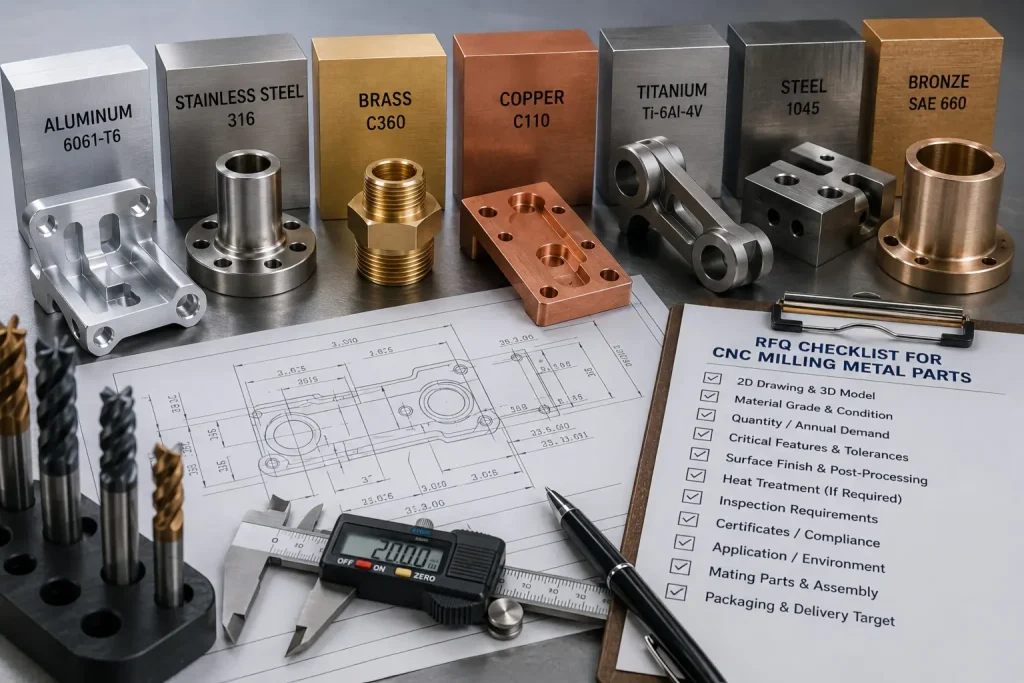
CNC milling metals is not only a machining decision.
It is also a material decision.
Two parts may look similar on a drawing, but the best metal can change depending on:
- strength
- weight
- corrosion resistance
- thermal conductivity
- electrical conductivity
- wear behavior
- surface finish
- tolerance
- cost
- quantity
- post-processing
- final application
A buyer may ask for “metal CNC milling,” but that is not enough for a reliable quotation.
Aluminum, stainless steel, brass, copper, titanium, and tool steel all behave differently during milling. They also create different risks for tool wear, burrs, surface finish, inspection, lead time, and total part cost.
The best CNC milling metal is not always the strongest material.
It is the material that fits the part function, machining route, tolerance requirement, finish requirement, and budget.
CNC Milling Metals Are Not Interchangeable
Many RFQ problems start when a metal is selected too early.
For example:
- aluminum may be easy to machine, but it may not survive a high-temperature or high-wear environment
- stainless steel may resist corrosion, but it can increase tool wear, heat, and machining cost
- copper may conduct heat and electricity well, but it can be sticky and burr-sensitive
- brass may machine cleanly, but the alloy and lead content may matter for regulation
- titanium may provide high strength-to-weight performance, but it needs careful toolpath and heat control
- steel may be strong and affordable, but rust prevention and heat treatment may need review
Choosing the wrong metal can create problems after machining:
- part deformation
- poor surface finish
- unexpected burrs
- assembly failure
- corrosion issue
- galling or thread damage
- coating failure
- cost increase
- delivery delay
- inspection disagreement
A material should be selected with the part function in mind.
For CNC milling capability, see our CNC milling services page.
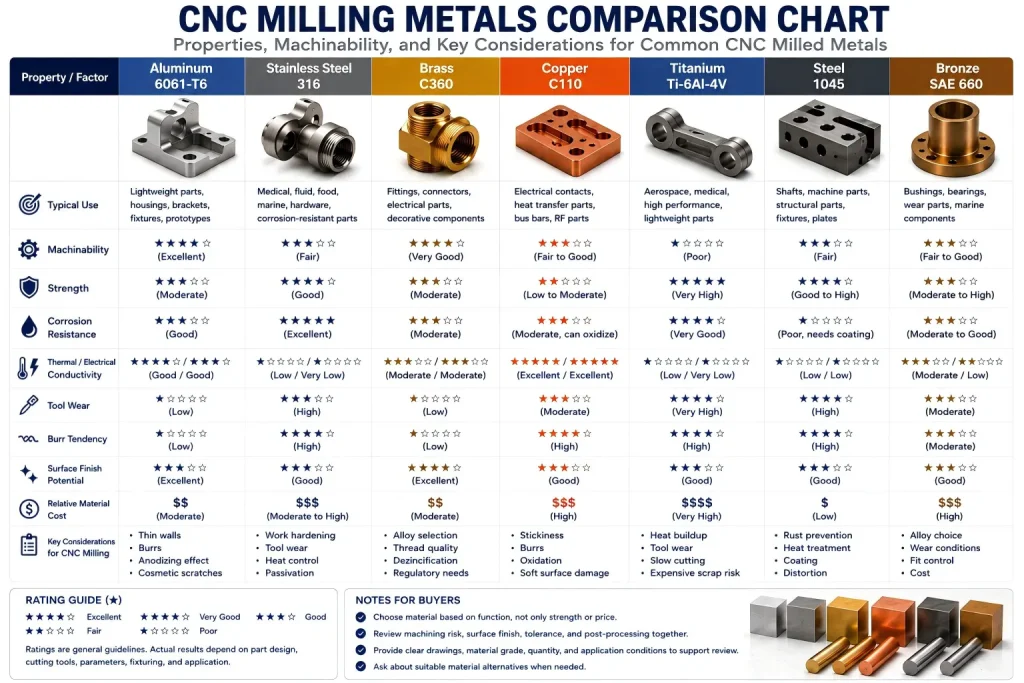
Quick CNC Milling Metals Comparison
The table below gives a practical starting point for common CNC milled metals.
| Metal | Common Reason to Use It | Main Milling Concern |
|---|---|---|
| Aluminum | Lightweight, easy to machine, good cost balance | Thin-wall deformation, burrs, anodizing effect, cosmetic scratches |
| Stainless steel | Corrosion resistance, strength, clean appearance | Work hardening, tool wear, heat, burrs, passivation |
| Brass | Good machinability, good appearance, low friction | Alloy selection, thread quality, dezincification risk in some environments |
| Copper | Electrical and thermal conductivity | Stickiness, burrs, tool marks, oxidation, soft surface damage |
| Titanium | High strength-to-weight ratio, corrosion resistance | Heat, tool wear, low cutting speed, expensive scrap risk |
| Carbon steel | Strength, cost, availability | Rust, heat treatment, coating, distortion |
| Tool steel | Wear resistance, hardness after heat treatment | Hardness, heat treatment movement, tool wear |
| Bronze | Wear behavior, bushings, bearing surfaces | Alloy choice, cost, burrs, fit control |
| Magnesium | Lightweight | Fire risk, supplier capability, handling controls |
| Zinc alloy | Good casting route and some machining needs | Often better as casting plus finishing, not always ideal for milled-from-solid parts |
This table is only a starting point.
The final choice depends on the drawing, application, quantity, finish, and inspection requirement.
Aluminum: The Most Common CNC Milling Metal
Aluminum is one of the most common CNC milling metals because it offers a strong balance of machinability, weight, cost, corrosion resistance, and finish options.
It is often used for:
- housings
- brackets
- plates
- covers
- fixtures
- prototypes
- heat sinks
- automation parts
- electronic enclosures
- aerospace-style lightweight parts
- robotic components
Common aluminum milling grades include:
| Aluminum Grade | Typical Use |
|---|---|
| 6061 | General CNC milled parts, brackets, housings, fixtures |
| 7075 | Higher strength parts, aerospace-style components, loaded structures |
| 5052 | Sheet and plate parts, corrosion resistance, formed parts |
| 6082 | Structural parts and machined components in some markets |
| 2024 | High strength applications, but corrosion protection needs review |
Aluminum is often a good default choice when the part needs moderate strength, lower weight, fast machining, and flexible finishing.
However, aluminum is not risk-free.
Aluminum milling should review:
- thin-wall stability
- chip evacuation
- burr-sensitive edges
- internal corner radius
- surface scratches
- anodizing thickness
- flatness after material removal
- thread strength
- press-fit features
- cosmetic surface requirements
If the part is aluminum-specific, see our CNC aluminum machining services page.
Stainless Steel: Stronger, Cleaner, but Slower to Mill
Stainless steel is often selected when corrosion resistance, strength, heat resistance, or clean appearance matters.
It is common in:
- medical device parts
- fluid system parts
- food equipment parts
- marine components
- hardware
- shafts
- brackets
- sensor housings
- valve components
- precision mechanical parts
Common stainless steel grades include:
| Stainless Steel Grade | Typical Use |
|---|---|
| 304 | General corrosion-resistant parts |
| 316 | Better corrosion resistance, marine and chemical environments |
| 303 | Improved machinability, but corrosion resistance differs from 304/316 |
| 17-4 PH | Higher strength stainless parts after heat treatment |
| 420 / 440C | Wear-resistant or hardened applications, depending on requirement |
Stainless steel milling needs more process control than aluminum.
Common risks include:
- tool wear
- heat buildup
- work hardening
- burrs
- thread galling
- poor chip evacuation
- slow machining speed
- surface scratches
- passivation requirement
- distortion in thin features
A buyer should not choose stainless steel only because it sounds stronger.
The grade should match corrosion environment, strength requirement, machining cost, and finishing plan.
For deeper material guidance, see our stainless steel CNC machining guide.
Brass: Easy to Machine, but Alloy Choice Still Matters
Brass is often one of the easiest metals to machine.
It can produce clean features, good threads, and attractive surfaces.
Brass is often used for:
- fittings
- terminals
- connectors
- electrical parts
- decorative components
- bushings
- small mechanical parts
- low-friction components
- valve parts
- threaded inserts
Brass milling is usually more stable than copper, but the exact alloy matters.
Buyers should review:
- lead content
- regulatory requirement
- corrosion environment
- dezincification risk
- plating or polishing requirement
- thread quality
- burr control
- surface appearance
- electrical function
- fit with mating metals
Brass can be a strong choice for small precision parts, especially when the part needs good machinability and clean threads.
But it may not be suitable for every fluid, food-contact, or regulatory application.
For brass and copper comparison, see our difference between brass and copper guide.
Copper: Conductive, Valuable, and Burr-Sensitive
Copper is selected when electrical conductivity, thermal conductivity, or specific copper properties are important.
It is common in:
- electrical contacts
- heat transfer parts
- bus bars
- connectors
- grounding parts
- thermal plates
- RF components
- custom conductive parts
- battery-related components
- high-conductivity prototypes
Copper milling can be more difficult than many buyers expect.
Copper can be soft, sticky, and burr-prone. It may also show tool marks or handling scratches more easily than harder metals.
Copper milling should review:
| Copper Feature | What to Review |
|---|---|
| Thin edges | Burrs and deformation |
| Conductive surfaces | Scratches, oxidation, and finish |
| Threaded holes | Burrs, thread quality, and mating screw |
| Flat thermal faces | Flatness, tool marks, and surface direction |
| Small holes | Drill wander and exit burrs |
| Cosmetic copper surfaces | Handling and oxidation protection |
| Plated copper parts | Coating thickness and adhesion |
| High-conductivity requirements | Exact copper grade and certificate need |
Do not treat copper like aluminum.
Even if the geometry is similar, the cutting behavior and burr control can be very different.
For copper-specific machining, see our Copper CNC Machining guide.
Titanium: Useful but Expensive to Mill
Titanium is selected when the part needs a strong combination of low weight, corrosion resistance, and high strength-to-weight performance.
It may be used for:
- aerospace-style parts
- medical-related components
- high-performance brackets
- lightweight structural parts
- marine parts
- chemical environment parts
- precision mechanical components
Titanium is not selected because it is easy.
Titanium milling needs careful review because it can create:
- heat buildup
- tool wear
- low cutting speed
- poor chip evacuation
- high scrap cost
- difficult threads
- galling risk
- surface damage
- workholding challenges
- long lead time
Titanium should be chosen when the application truly needs its properties.
If the part can use aluminum, stainless steel, or another material, the buyer should compare total cost and performance before selecting titanium.
A titanium RFQ should clearly state:
- titanium grade
- quantity
- critical features
- surface finish
- thread requirements
- inspection requirement
- certificate requirement
- application condition
- delivery target
For a simple prototype bracket, titanium may be overkill.
For a high-performance part with weight, strength, and corrosion requirements, it may be justified.
Carbon Steel and Alloy Steel: Strong and Practical
Carbon steel and alloy steel are common CNC milling metals when the part needs strength, durability, availability, or cost control.
They are often used for:
- tooling plates
- machine parts
- brackets
- shafts
- structural components
- fixtures
- hardened wear parts
- low-cost mechanical parts
- industrial equipment components
Steel selection depends on:
- strength
- hardness
- machinability
- heat treatment
- coating
- corrosion risk
- welding requirement
- surface finish
- final environment
A soft steel part may machine easily but need coating to prevent rust.
A hardened steel part may need different tooling, slower machining, and grinding or EDM in some areas.
Steel RFQs should clarify:
- exact grade
- heat treatment condition
- hardness requirement
- coating or plating requirement
- corrosion environment
- tolerance before or after heat treatment
- flatness and distortion requirement
Heat treatment is especially important.
A steel part can change size or shape after heat treatment. If final tolerance is critical, the process should define whether machining happens before heat treatment, after heat treatment, or in multiple stages.
Bronze: Good for Wear, Bushings, and Bearing Surfaces
Bronze is often used for wear-related parts, bushings, sliding components, and bearing surfaces.
It may be selected for:
- bushings
- bearings
- wear plates
- sliding blocks
- marine components
- heavy equipment parts
- valve components
- low-speed friction parts
Bronze is not just “strong brass.”
Different bronze alloys can behave differently in machining, wear, corrosion, and cost.
Buyers should review:
- bronze alloy
- load condition
- sliding speed
- lubrication
- mating shaft material
- surface finish
- bore tolerance
- wall thickness
- wear requirement
- corrosion environment
- quantity and cost
For bushings, the bore and surface finish often matter more than the outer cosmetic shape.
The RFQ should identify the functional sliding or bearing surface clearly.
Material Choice by Part Function
A better way to choose CNC milling metals is to start from the part function.
| Part Function | Common Material Direction |
|---|---|
| Lightweight bracket | 6061 aluminum, 7075 aluminum, or titanium if performance requires |
| Corrosion-resistant hardware | 304 stainless steel, 316 stainless steel, or coated steel |
| Electrical contact | Copper, brass, or plated copper alloy |
| Heat transfer part | Aluminum or copper |
| Wear bushing | Bronze, brass, Delrin, or other bearing material depending on load |
| Decorative metal part | Aluminum, brass, stainless steel, or plated material |
| High-strength compact part | 7075 aluminum, alloy steel, stainless steel, or titanium |
| Low-cost mechanical part | Aluminum, carbon steel, or suitable brass/steel |
| Fluid-contact part | 316 stainless steel, brass, bronze, or specific alloy depending on fluid |
| Precision fixture | Aluminum, steel, stainless steel, or engineering plastic depending on use |
This table does not replace engineering review.
It helps buyers avoid choosing a metal only by name.
Material Choice by Manufacturing Risk
Some metals look attractive on paper but create extra manufacturing risk.
| Risk Type | Material Concern |
|---|---|
| Burr control | Copper, stainless steel, soft aluminum, brass depending on alloy |
| Tool wear | Stainless steel, titanium, hardened steel, abrasive alloys |
| Thin-wall deformation | Aluminum, copper, some stainless parts, thin steel plates |
| Heat buildup | Stainless steel, titanium, copper, hardened steel |
| Surface scratches | Aluminum, copper, brass, polished stainless steel |
| Thread galling | Stainless steel, titanium |
| Coating thickness | Aluminum anodizing, steel plating, copper plating, nickel plating |
| Flatness after machining | Large aluminum plates, copper plates, steel after heat treatment |
| Material cost risk | Titanium, copper, specialty stainless, bronze |
| Lead time risk | Uncommon alloys, certified material, special heat treatment |
A low material price does not always mean low total cost.
If the material creates slow machining, high scrap risk, difficult inspection, or special post-processing, total cost may increase.
Tolerance Depends on Metal and Geometry
CNC milling tolerance is not only controlled by the machine.
It is also affected by material behavior.
Tolerance can be affected by:
- part size
- material hardness
- cutting heat
- wall thickness
- internal stress
- fixture support
- tool wear
- burr control
- surface finish
- post-processing
- heat treatment
- inspection method
For example:
- a small aluminum block may be easy to hold accurately
- a large thin aluminum plate may move after material removal
- a stainless steel part may need slower cutting to control heat and tool wear
- a copper part may need extra burr and surface review
- a steel part may move after heat treatment
- a titanium part may require careful toolpath and inspection planning
Do not apply the same tolerance expectation to every metal and every feature.
For general tolerance planning, see our CNC machining tolerances guide.
Surface Finish and Post-Processing Change the Decision
The final surface condition can affect material choice.
Common finish decisions include:
| Finish Need | Material Review |
|---|---|
| Clear anodizing | Aluminum grade and cosmetic quality matter |
| Hard anodizing | Aluminum grade, thickness, and tolerance impact need review |
| Passivation | Stainless steel grade and cleanliness matter |
| Bead blasting | Surface uniformity and contamination risk need review |
| Polishing | Material hardness and geometry affect cost |
| Plating | Base metal, adhesion, thickness, masking, and tolerance impact matter |
| Black oxide | Usually steel-focused; stainless needs route review |
| Powder coating | Masking, thickness, and fit areas must be defined |
| Heat treatment | Steel and some alloys may move after treatment |
A material can be easy to mill but hard to finish.
A drawing should define which surfaces are cosmetic, functional, coated, masked, or inspected after finishing.
For finish comparison, see our CNC surface finishes guide.
Threads, Fits, and Mating Metals
Threads and fits are often where CNC milling metal choices create assembly problems.
Examples:
| Feature | Material-Related Risk |
|---|---|
| Stainless thread | Galling risk with stainless mating screw |
| Aluminum thread | Thread strength may be lower than steel |
| Copper thread | Burrs and deformation may affect assembly |
| Titanium thread | Galling and tool wear need review |
| Brass thread | Usually clean, but alloy and load still matter |
| Press-fit pin in aluminum | Hole tolerance and wall thickness need review |
| Steel dowel hole | Heat treatment and final sizing may matter |
| Bearing seat | Roundness, surface finish, and final inspection matter |
| Sealing thread | Surface finish, coating, and burrs matter |
A drawing should not only state thread size.
It should define whether the thread is:
- for light assembly
- repeatedly assembled
- load-bearing
- sealing
- cosmetic
- used with a metal insert
- used with a stainless screw
- inspected by gauge
- protected by coating or masking
This helps the supplier plan machining, deburring, and inspection.
Cost Is Not Only Material Price
Material price is only one part of CNC milling cost.
Total cost may include:
- material price
- stock availability
- certificate requirement
- setup time
- machining time
- tool wear
- fixture cost
- scrap risk
- inspection time
- finishing cost
- packaging
- delivery time
- rework risk
For example:
- aluminum material may cost more than mild steel in some cases, but it can machine faster
- stainless steel may need slower cutting and more tool changes
- titanium material and machining both increase cost
- copper material is valuable and may need extra handling
- brass may machine quickly but regulatory or alloy choice may matter
- steel may be affordable but coating or heat treatment can add steps
The best material is the one that gives the right function at the right total project cost.
When to Ask the Supplier Before Choosing the Metal
Buyers should ask for material review before finalizing the drawing when the part has:
- tight tolerance
- thin walls
- deep pockets
- high surface finish requirement
- sealing surfaces
- press fits
- repeated assembly threads
- high load
- corrosive environment
- heat exposure
- electrical or thermal conductivity requirement
- weight limit
- coating or plating requirement
- certification requirement
- expensive material
- short delivery target
Early review can prevent redesign, re-quoting, and unnecessary cost.
The supplier does not need to choose the material blindly.
The supplier needs enough information to review whether the selected metal fits the process and application.
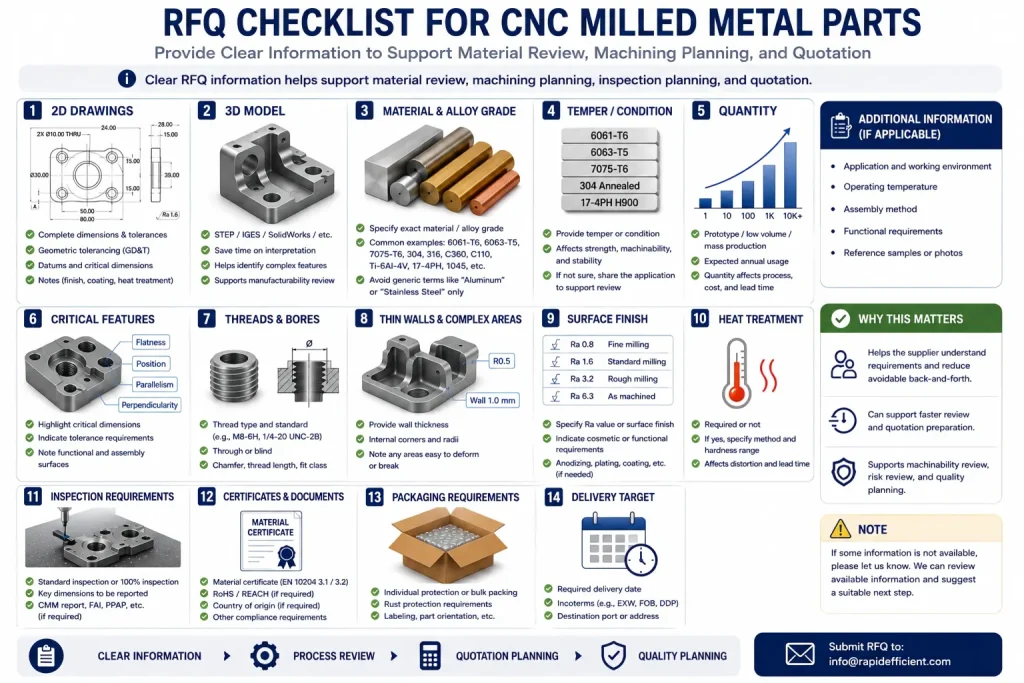
RFQ Checklist for CNC Milling Metals
Before requesting a CNC milling quote, provide information that helps the supplier review the material and machining route.
| RFQ Item | What to Provide |
|---|---|
| 2D drawing | Dimensions, tolerances, datums, GD&T, surface finish, and critical features |
| 3D model | STEP / STP / IGES / X_T file |
| Material grade | Exact alloy, temper, hardness, or equivalent grade rule |
| Quantity | Prototype, low-volume batch, or repeat production |
| Critical features | Threads, bores, sealing faces, thin walls, datum faces, press fits, cosmetic surfaces |
| Application condition | Load, temperature, corrosion, chemical exposure, wear, conductivity, or weight limit |
| Mating parts | Screws, shafts, pins, bearings, seals, housings, inserts, or assemblies |
| Surface finish | Ra value, cosmetic standard, coating, polishing, bead blasting, anodizing, passivation |
| Heat treatment | Required hardness, condition before/after machining, and final inspection stage |
| Inspection requirement | CMM report, first article inspection, gauge check, material certificate, or full inspection |
| Regulatory need | RoHS, REACH, food-contact, medical, aerospace, or industry-specific requirement if needed |
| Packaging need | Protect cosmetic surfaces, threads, sealing faces, or soft metal parts |
| Delivery target | Helps review material availability, process route, and inspection timing |
A good RFQ does not only say “metal CNC part.”
It explains what the part must do, what material is required, and which features control function.
Practical Drawing Notes for CNC Milling Metals
Example 1: Aluminum Cosmetic Housing
Material: 6061-T6 aluminum. Visible surfaces require uniform bead blast and clear anodizing. Mask threaded holes if required. Supplier to review cosmetic faces before production.
This connects the material, finish, and inspection requirement.
Example 2: Stainless Steel Fluid Part
Material: 316 stainless steel. Sealing face is functional. Supplier to review flatness, surface finish, burr control, and passivation requirement.
This helps prevent leakage and finishing disputes.
Example 3: Copper Conductive Part
Material: C110 copper or approved equivalent. Contact faces are functional. Supplier to review burr control, oxidation protection, and packaging method.
This protects conductive surfaces.
Example 4: Titanium Bracket
Material: Ti-6Al-4V. Critical holes are datum-related. Supplier to review tool access, thread quality, inspection method, and certificate requirement.
This helps control expensive material risk.
Example 5: Steel Heat-Treated Part
Material: alloy steel, heat treated to specified hardness after rough machining. Final tolerance applies after heat treatment and finish machining.
This prevents tolerance confusion before and after heat treatment.
Rapid Efficient Support for CNC Milling Metal Parts
Rapid Efficient can review custom CNC milled metal parts according to geometry, material grade, tolerance, surface finish, inspection need, and delivery target.
We can review:
- aluminum CNC milling
- stainless steel CNC milling
- brass and copper milling
- titanium milling
- steel and alloy steel parts
- bronze and wear parts
- material grade selection
- surface finish route
- tight tolerance features
- thin-wall parts
- threads and inserts
- sealing faces
- CMM inspection needs
- prototype and low-volume production plans
For broader CNC machining support, see our CNC machining services page.
If you are not sure which metal is suitable for your CNC milled part, send the 2D drawing, 3D model, application condition, tolerance notes, surface finish requirement, and quantity. We can review the project and suggest a suitable material and machining route.
Buyer Questions About CNC Milling Metals
What metals can be CNC milled?
Common CNC milling metals include aluminum, stainless steel, brass, copper, titanium, carbon steel, alloy steel, tool steel, bronze, and specialty alloys. The best choice depends on part function, tolerance, finish, cost, and application environment.
What is the easiest metal to CNC mill?
Aluminum and many brass alloys are often easier to machine than stainless steel, titanium, or hardened steel. However, the easiest metal is not always the best material for the application.
Is aluminum better than stainless steel for CNC milling?
Aluminum is lighter, easier to machine, and often more cost-effective. Stainless steel is stronger in many conditions and offers better corrosion resistance depending on grade. The better choice depends on strength, weight, corrosion, finish, and cost target.
Which CNC milling metal is best for heat transfer?
Copper and aluminum are commonly used for heat transfer parts. Copper has high thermal conductivity, while aluminum offers lower weight and easier machining. The final choice depends on design, cost, surface finish, and assembly.
Which metal is best for corrosion resistance?
Stainless steel, especially 316, is often selected for corrosion resistance. Aluminum, brass, bronze, titanium, and coated steels may also be suitable depending on the environment.
What files should I send for CNC milled metal parts?
Send a 2D drawing, 3D model, material grade, quantity, critical features, tolerance notes, surface finish requirement, coating or heat treatment notes, inspection needs, and application conditions.