
Quick Answer: Should You Choose HSS or Carbide Tools?
Choose high-speed steel, or HSS, when the operation needs greater toughness, lower tooling cost, easier regrinding, or better resistance to shock and interrupted cutting.
Choose cemented carbide when the machine, fixture, and toolholder are rigid enough to support higher cutting speeds, stronger wear resistance, and longer tool life in stable production.
The term “tungsten steel” is commonly used in some supplier markets to describe tungsten carbide or cemented carbide. It is not a standard English name for a conventional steel grade.
Carbide is not automatically the better choice for every CNC operation. The correct tool material depends on the workpiece, operation, tool diameter, machine capability, tool overhang, coolant, production quantity, surface requirement, and cost per finished part.
1. What Are High-Speed Steel and Cemented Carbide?
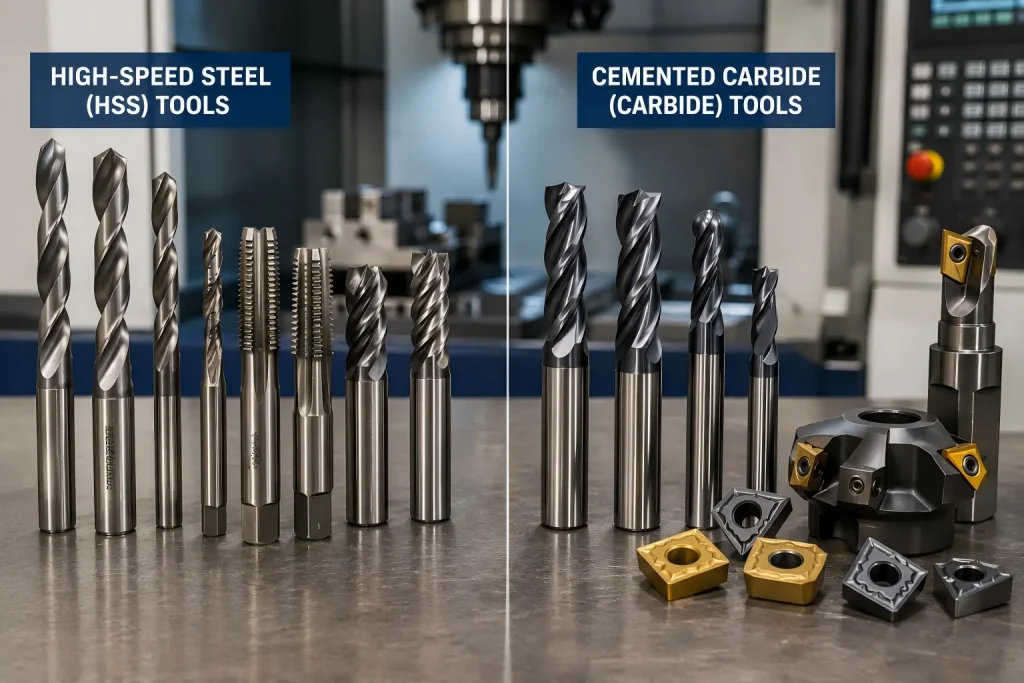
High-speed steel is a heat-treated tool steel used to make drills, taps, reamers, milling cutters, broaches, form tools, and other cutting tools.
Common HSS families include:
- M2 general-purpose HSS
- Cobalt-alloyed grades such as M35 and M42
- Powder-metallurgy HSS
- Tungsten-type HSS grades
- Coated and uncoated HSS tools
HSS combines hardness with relatively good toughness. This allows a cutting edge to tolerate vibration, shock, interrupted contact, and less-rigid machining conditions better than many carbide tools.
Cemented carbide is a composite tool material rather than a conventional steel. A typical grade contains hard tungsten carbide particles held together by a metallic binder, commonly cobalt.
Carbide grades can be adjusted through:
- Tungsten carbide grain size
- Binder percentage
- Binder chemistry
- Additional carbide phases
- Surface coating
- Cutting-edge preparation
A harder carbide grade may provide better wear resistance but lower fracture toughness. A tougher carbide grade may better resist chipping but provide less abrasion resistance.
The comparison should therefore be between a defined HSS grade and a defined carbide grade—not simply “steel versus tungsten.”
2. Composition and Material Structure
High-speed steel is an iron-based alloy. Depending on the grade, its composition may include:
- Carbon
- Chromium
- Molybdenum
- Tungsten
- Vanadium
- Cobalt
These alloying elements and the heat-treatment route control hardness, hot hardness, carbide distribution, wear resistance, toughness, and edge stability.
Not every HSS grade contains the same amount of tungsten or cobalt. For example, M2 is a widely used molybdenum-tungsten HSS, while cobalt-alloyed HSS grades are selected when higher hot hardness is needed.
Cemented carbide has a different structure. It normally contains:
- Tungsten carbide particles
- A metallic binder, commonly cobalt
- Optional additional carbides or alloying additions
- An optional wear-resistant coating
The tungsten carbide particles provide hardness and abrasion resistance. The binder holds the particles together and contributes to toughness.
Increasing binder content or using coarser carbide grains can improve fracture toughness, but usually reduces hardness and abrasion resistance. Reducing binder content or using finer grains can increase hardness and wear resistance, but may make the grade more sensitive to chipping.
This hardness-versus-toughness balance is why carbide suppliers offer many grades for different cutting conditions.
HSS vs Carbide Tools: Quick Comparison
| Comparison Item | High-Speed Steel | Cemented Carbide | Practical Meaning |
|---|---|---|---|
| Material type | Heat-treated iron-based tool steel | Tungsten carbide particles in a metallic binder | They are different material families |
| Hardness reporting | Commonly specified in HRC | Commonly specified in HRA or HV, depending on grade | Do not directly compare raw HRC and HRA values |
| Toughness | Generally higher | Generally lower, but varies by grade | HSS is often more tolerant of shock and unstable setups |
| Wear resistance | Good, depending on grade and coating | Generally higher in stable cutting | Carbide often lasts longer in repeat production |
| Hot hardness | Good | Generally supports higher cutting temperatures and speeds | Carbide often enables higher productivity |
| Edge chipping risk | Usually lower | Higher when setup, runout, or engagement is unstable | Carbide requires better process control |
| Cutting speed | Usually lower | Usually higher when conditions are suitable | Machine and fixture rigidity matter |
| Small tool flexibility | Good for many small drills, taps, and form tools | Excellent for many solid tools, but more brittle | Choose by diameter and operation |
| Regrinding | Often easier and more economical | Possible, but geometry and coating restoration may be more demanding | HSS can be practical for reusable special tools |
| Initial tool cost | Often lower | Often higher | Initial cost is not the same as cost per part |
| Best fit | Low-volume work, interrupted cuts, special forms, less-rigid conditions | Stable CNC production, higher speed, abrasive workpieces, longer runs | Neither is universally better |
3. Hardness, Wear Resistance, and Toughness
Hardness helps a cutting edge resist deformation and abrasive wear, but hardness alone does not determine whether a tool will perform reliably.
A useful cutting-tool material must balance:
- Hardness
- Wear resistance
- Fracture toughness
- Edge stability
- Hot hardness
- Compressive strength
- Resistance to thermal and mechanical shock
HSS Behavior
Properly heat-treated HSS provides high hardness while retaining more toughness than cemented carbide in many applications.
This can make HSS useful when:
- The cut is interrupted
- The setup is less rigid
- The tool is long or slender
- The machine has limited spindle speed
- The tool geometry is complex
- The cutting edge may experience shock
- A small batch does not justify higher tool cost
HSS tools can still chip or wear rapidly if cutting speed, heat treatment, tool geometry, or coolant conditions are unsuitable.
Carbide Behavior
Cemented carbide generally provides higher wear resistance and compressive strength, allowing stable tools to operate at higher cutting speeds.
However, carbide is more sensitive to:
- Excessive runout
- Chatter
- Interrupted engagement
- Poor workholding
- Long tool overhang
- Incorrect edge preparation
- Thermal shock
- Sudden changes in cutting load
A carbide tool that chips early may cost more per part than an HSS tool running at a lower but stable speed.
The correct choice is therefore not “harder is always better.” The goal is to select enough wear resistance without sacrificing the toughness required by the operation.
4. Hot Hardness and Cutting Speed
Hot hardness describes a cutting-tool material’s ability to retain hardness and edge strength as the cutting zone becomes hotter.
Both HSS and carbide are designed to resist heat better than ordinary carbon steel tools, but carbide generally supports higher cutting speeds when the machining system is stable.
Carbide’s productivity advantage is most useful when the process has:
- Adequate spindle speed and power
- Low tool runout
- Rigid workholding
- Short tool overhang
- Stable cutter engagement
- Suitable coolant or dry-cutting strategy
- Effective chip evacuation
- Enough production volume to use the available tool life
HSS may still be the more reliable choice when the operation is slow, interrupted, flexible, or difficult to support.
Coated HSS, cobalt HSS, powder-metallurgy HSS, coated carbide, uncoated carbide, and different carbide substrates also behave differently. The tool specification matters more than a simple material name.
The cutting temperature should not be controlled only by selecting a “more heat-resistant” tool. Cutting speed, feed, depth of cut, coolant, toolpath, chip evacuation, and workpiece material must be planned together.
5. Common CNC Applications for HSS and Carbide
Common HSS Tool Applications
HSS remains practical for:
- Twist drills
- Taps
- Reamers
- Broaches
- Countersinks
- Form cutters
- Gear-cutting tools
- Small special-purpose tools
- Tools that will be reground
- Interrupted or shock-loaded operations
HSS can be especially useful when the cutting edge needs toughness or when the machine cannot use carbide’s higher cutting-speed capability.
Cobalt HSS and powder-metallurgy HSS can extend the useful range of HSS where standard grades do not provide enough hot hardness or wear resistance.
Common Carbide Tool Applications
Cemented carbide is widely used for:
- Solid carbide end mills
- Solid carbide drills
- Indexable turning inserts
- Indexable milling inserts
- Reamers
- Boring tools
- Thread mills
- High-volume machining
- Abrasive workpiece materials
- High-speed finishing
- Stable roughing operations
Carbide is often preferred when cycle time, repeat tool life, and resistance to abrasive wear are important.
Tool Coatings Also Matter
Tool performance is not determined by the substrate alone.
Depending on the workpiece and operation, tools may use coatings or polished surfaces to control:
- Adhesion
- Built-up edge
- Abrasive wear
- Heat flow
- Friction
- Crater wear
- Edge chipping
For aluminum milling, flute geometry, edge sharpness, chip space, coating choice, and chip evacuation can be as important as choosing HSS or carbide.
For a focused comparison of flute count, geometry, coating, and tool reach, see our aluminum milling cutter selection guide.
6. Effect on Cycle Time, Tool Life, and Dimensional Control
Tool material affects machining efficiency, but it does not work independently from the rest of the process.
Cycle Time
Carbide may support a higher cutting speed and material-removal rate when the machine, fixture, toolholder, and part are stable.
HSS may require a lower cutting speed, but it can provide a more reliable process when vibration, interrupted cutting, or limited machine rigidity would cause carbide chipping.
Tool Life
Carbide often provides longer wear life in stable repeat production. However, premature chipping can end tool life before normal wear develops.
HSS may wear faster, but gradual wear can sometimes be easier to monitor than unexpected carbide fracture.
Tool life should be evaluated by:
- Number of acceptable parts
- Cutting time
- Tool-change frequency
- Tool-adjustment time
- Scrap risk
- Surface-finish stability
- Dimensional drift
- Cost of regrinding or replacement
Dimensional Control
A carbide tool does not automatically produce a tighter tolerance.
Final dimensional results also depend on:
- Machine condition
- Tool runout
- Toolholder rigidity
- Tool deflection
- Cutting parameters
- Workholding
- Thermal movement
- Tool-wear compensation
- Inspection timing
- Part geometry
Carbide’s wear resistance may reduce gradual tool-size change during a stable production run. But if the tool chips, chatters, or deflects, dimensional consistency can become worse.
For guidance on how tooling, setup count, material, tolerance, and inspection affect total machining performance, see our CNC turning and milling efficiency guide.
7. Tool Cost vs Cost per Finished Part
HSS tools often have a lower initial purchase cost, but the cheapest tool is not always the lowest-cost production choice.
The real comparison should include:
- Tool purchase price
- Regrinding cost
- Coating cost
- Tool life
- Cutting speed
- Machine time
- Tool-change time
- Offset adjustment
- Scrap risk
- Surface-finish consistency
- Unplanned tool failure
- Batch quantity
When HSS May Cost Less Overall
HSS may provide the lower total cost when:
- The batch is small
- Cutting speed is not the bottleneck
- The machine has limited spindle speed
- The cut is interrupted
- Tool toughness is more important than wear resistance
- A special tool will be reground several times
- Carbide chipping risk is high
- The operation uses a hand or machine tap under variable conditions
When Carbide May Cost Less Overall
Carbide may provide the lower cost per part when:
- The setup is rigid and repeatable
- The machine can use higher cutting speeds
- The production quantity is large enough
- Tool-change downtime is expensive
- The workpiece is abrasive
- Longer stable tool life reduces adjustment
- Cycle-time reduction has meaningful value
- The process can monitor wear before failure
A useful comparison is:
Total tooling and machine cost ÷ number of accepted parts
This approach is more meaningful than comparing only the price of one HSS tool with one carbide tool.
For more information about flank wear, built-up edge, chipping, and parameter-related tool failure, see our guide to machining wear and its prevention.
8. How to Choose Between HSS and Carbide Tools
Start with the operation rather than the tool-material name.
| Machining Condition | HSS May Be Better | Carbide May Be Better |
|---|---|---|
| Small prototype batch | Lower initial cost and flexible tooling | When cycle time or abrasive wear is still critical |
| Large repeat batch | When the operation is slow or interrupted | Longer stable tool life and higher productivity |
| Interrupted cutting | Higher toughness can reduce sudden fracture | Use only with a suitable tough carbide grade and stable setup |
| High spindle speed | May not use the full machine capability | Usually better suited to high-speed CNC machining |
| Limited machine rigidity | More tolerant in some unstable conditions | Chatter and chipping risk may increase |
| Abrasive workpiece | May wear more quickly | Often provides better wear resistance |
| Small taps and form tools | HSS or cobalt HSS is often practical | Carbide can work, but setup and tool fragility need review |
| Long tool overhang | Toughness can help, but deflection remains a risk | Requires carefully controlled geometry and cutting load |
| Regrindable special tools | Often practical and economical | Possible, but edge geometry and coating may be more difficult to restore |
| Stable aluminum milling | Can work at moderate speeds | Sharp carbide tools are common for productivity and finish |
| Uncertain or variable setup | More forgiving in some cases | Best when the cutting conditions are repeatable |
Before selecting a tool, confirm:
- Workpiece material and hardness
- Milling, turning, drilling, tapping, or reaming
- Continuous or interrupted cutting
- Tool diameter
- Tool reach and overhang
- Machine spindle speed and power
- Toolholder and workholding rigidity
- Coolant or dry-cutting condition
- Required surface finish
- Batch quantity
- Acceptable tool-change frequency
- Tool failure consequences
The correct answer may also be coated HSS, cobalt HSS, powder-metallurgy HSS, a tougher carbide grade, a wear-resistant carbide grade, or an indexable tool rather than a simple HSS-or-carbide choice.
Tool Selection Information to Confirm Before Production
A complete tooling decision requires more information than the workpiece material name.
| Information | What to Confirm | Why It Matters |
|---|---|---|
| Operation | Milling, turning, drilling, tapping, reaming, or boring | Different operations load the cutting edge differently |
| Workpiece | Exact material grade, hardness, coating, or heat treatment | Controls wear, heat, adhesion, and cutting force |
| Feature | Diameter, depth, corner radius, thread, or surface requirement | Determines tool geometry and access |
| Machine | Spindle speed, power, torque, and rigidity | Determines whether higher carbide cutting speeds can be used |
| Toolholding | Collet, hydraulic holder, shrink fit, chuck, or insert holder | Runout and rigidity affect edge life |
| Engagement | Continuous or interrupted cutting | Influences chipping and toughness requirements |
| Tool overhang | Required reach and unsupported length | Longer reach increases deflection and vibration |
| Coolant | Flood, through-tool, mist, air blast, or dry cutting | Changes chip evacuation and thermal conditions |
| Quantity | Prototype, low volume, or repeat production | Determines whether higher tool investment is justified |
| Acceptance | Tolerance, roughness, burr limits, and inspection plan | Defines the required tool stability |
Rapid Efficient can review the drawing, workpiece material, feature access, tolerance priorities, surface finish, quantity, and machining route before quotation. The final cutting-tool grade and parameters should be confirmed for the actual machine, setup, and production conditions.
9. Conclusion
High-speed steel and cemented carbide solve different cutting-tool problems.
HSS generally provides greater toughness, a lower initial cost, easier regrinding, and better tolerance of some interrupted or less-rigid cutting conditions.
Carbide generally provides greater wear resistance, stronger hot hardness, and the ability to use higher cutting speeds when the machine, toolholder, fixture, and toolpath are stable.
The correct decision should consider:
- Tool grade
- Workpiece material
- Type of operation
- Continuous or interrupted cutting
- Machine capability
- Tool reach
- Workholding rigidity
- Coolant
- Batch quantity
- Required finish
- Tool-failure risk
- Cost per accepted part
Do not select carbide only because it is harder, and do not select HSS only because it is cheaper. The best tool is the one that provides stable cutting, acceptable tool life, predictable dimensions, and the lowest practical finished-part cost.
Review Your CNC Machining Project
Rapid Efficient can review your drawing, material, geometry, tolerance priorities, surface-finish requirements, inspection needs, and order quantity before quotation.
For custom housings, brackets, plates, pockets, slots, drilled features, and multi-surface components, review our CNC milling services.
FAQ: High-Speed Steel vs Carbide Tools
Is Tungsten Steel the Same as Tungsten Carbide?
The term “tungsten steel” is sometimes used informally for cemented tungsten carbide. In standard technical English, tungsten carbide or cemented carbide is clearer because the material is a carbide composite, not a conventional steel grade.
Is Carbide Always Better Than HSS?
No. Carbide usually provides higher wear resistance and supports higher cutting speeds, but HSS can be more reliable where toughness, interrupted cutting, lower machine rigidity, or lower tooling cost matter more.
Which Tool Material Is Better for High-Speed CNC Machining?
Carbide is generally the more practical choice when the machine, fixture, holder, and toolpath are rigid and stable enough to use higher cutting speeds. HSS may be more suitable when cutting conditions are unstable or the available spindle speed is limited.
Is HSS Better for Taps and Small Drills?
HSS and cobalt HSS are commonly used for taps, drills, and special tools because they provide useful toughness and can be economical to regrind. Carbide tools may provide higher productivity, but setup stability and tool fragility must be considered.
Does Carbide Produce Tighter Tolerances Than HSS?
Not automatically. Carbide’s wear resistance can help reduce tool-wear drift in stable production, but tolerance also depends on machine condition, runout, deflection, workholding, temperature, toolpath, compensation, and inspection.
Which Tool Material Is Cheaper?
HSS often has a lower initial tool price. Carbide can produce a lower cost per part when its longer tool life and higher cutting speed are fully used. The correct comparison includes machine time, tool changes, regrinding, scrap, and accepted-part quantity.
Can HSS Tools Be Reground?
Yes. Many HSS drills, reamers, form cutters, broaches, and other tools can be reground. The tool geometry, coating, remaining size, and required accuracy should be checked before reuse.
What Causes Carbide Tools to Chip?
Common causes include excessive runout, chatter, unstable workholding, interrupted cutting, excessive tool overhang, unsuitable grade, incorrect edge preparation, poor entry strategy, and sudden changes in cutting load.