CNC加工原理及安全注意事项: 实用指南

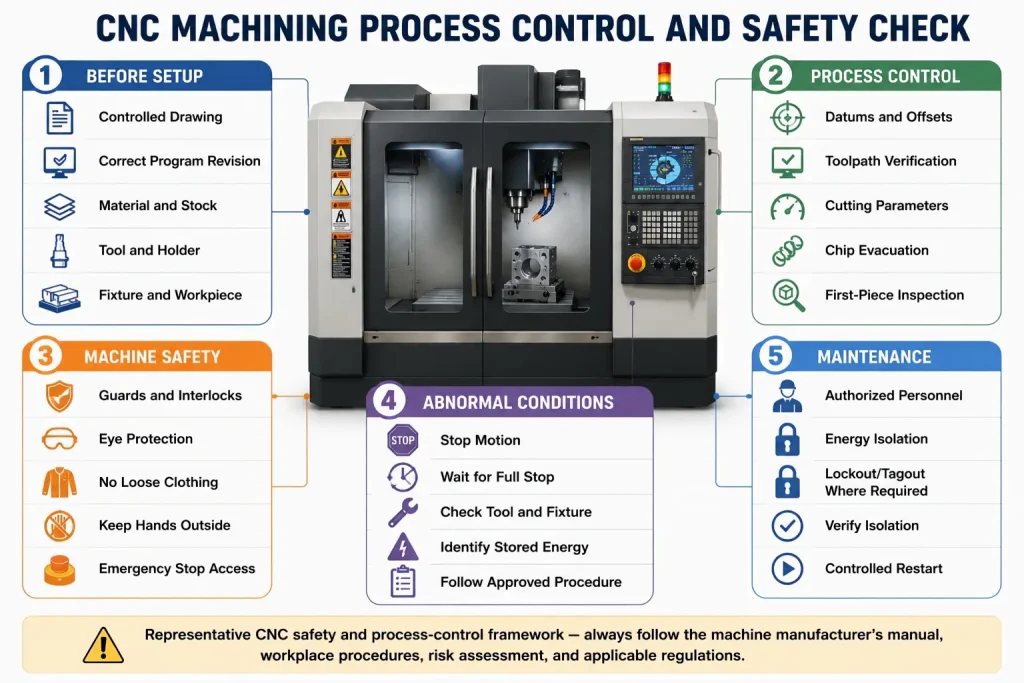
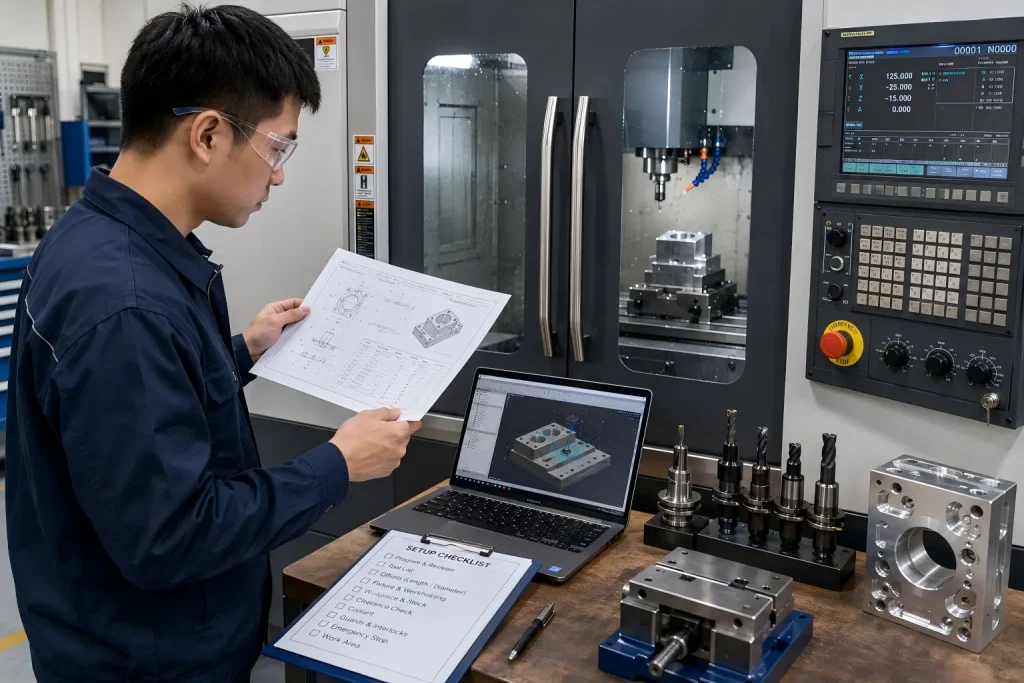
CNC operator reviewing the engineering drawing, CAM program, 切削工具, 夹具, workpiece setup, machine guards, and safety checklist before machining.

稳定的 CNC 加工不仅仅取决于输入程序和按下循环启动.

机器, 切削工具, 夹具, 工件, CNC program, offsets, 冷却液, 检查方法, and operator actions must work as one controlled system. A weakness in any one of these areas can cause dimensional errors, tool failure, machine damage, or personal injury.

Good machining principles focus on process stability and repeatability. Good safety practices prevent people from being exposed to rotating parts, moving axes, flying chips, 锋利的工具, 冷却液, unexpected machine movement, and stored energy.

This article provides general manufacturing and safety guidance. It is not a replacement for the machine manufacturer’s manual, formal operator training, workplace procedures, risk assessment, or applicable safety regulations.


快速解答

The main principles of stable CNC machining are:

  • Start with a controlled drawing, model, 程序, and revision.
  • Select suitable material, 工具, cutting conditions, 和工件夹持.
  • Establish repeatable datums and offsets.
  • Verify tool, 持有者, 夹具, stock, and machine clearance.
  • Separate roughing, 半精加工, and finishing when necessary.
  • Control chips, 热, 刀具磨损, and part distortion.
  • Inspect the first piece and critical features during production.
  • Record program, offset, 工装, and process changes.

Essential CNC machining safety precautions include:

  • Only trained and authorized personnel should operate the machine.
  • Use the required eye, face, hearing, footwear, and other protective equipment.
  • Keep machine guards, 门, and interlocks functional.
  • Do not reach into the machining area while motion is possible.
  • Keep loose clothing, 珠宝, hair, and unsuitable gloves away from rotating parts.
  • Confirm the tool, 持有者, 夹具, 工件, 程序, and offsets before cutting.
  • Stop the machine before removing chips, measuring the part, or checking a suspected problem.
  • Use an approved hazardous-energy isolation procedure before servicing or maintenance.
  • Follow the machine manual and the workplace’s approved operating procedure.

CNC Machining Is a Controlled System

A CNC machine follows programmed commands, but the program alone does not guarantee a correct part.

The final result also depends on:

  • Drawing and model accuracy
  • Material grade and condition
  • Stock size and orientation
  • 机器状况
  • 工件夹持刚性
  • 基准选择
  • 刀具几何形状
  • Tool length and runout
  • 切割参数
  • Toolpath strategy
  • Coolant and chip evacuation
  • 温度
  • Part stiffness
  • 检查方法
  • Operator verification

The process should therefore be treated as a connected system rather than a series of independent machine movements.


原则 1: Begin with Controlled Requirements

Machining should begin with the correct project information.

Before programming or setup, 确认:

  • 3D型
  • Controlled 2D drawing
  • Drawing revision
  • 材质等级
  • 脾气, 硬度, or heat-treatment condition
  • 数量
  • Functional datums
  • 关键尺寸
  • 几何公差
  • 线程数
  • 表面粗糙度
  • 表面处理
  • 检验要求
  • 包装要求

The 3D model normally defines geometry, while the controlled drawing defines dimensions, 日期, 公差, 完成, 线程, notes, and acceptance requirements.

Conflicts between the model, 绘画, purchase order, and RFQ should be resolved before production.

A machine can follow an incorrect program very accurately. Process control must therefore begin before the tool touches the material.


原则 2: Select a Stable Manufacturing Route

The process planner should decide which manufacturing method and setup sequence provide the best combination of access, 刚性, 重复性, and inspection capability.

Possible operations include:

  • 数控铣削
  • 数控车削
  • Turn-mill machining
  • Indexed multi-axis machining
  • Simultaneous five-axis machining
  • 钻孔
  • 无聊的
  • 铰孔
  • 螺纹铣削
  • 窃听
  • 研磨
  • EDM for suitable features

The most advanced machine is not automatically the best option.

A three-axis process with stable fixtures may be more reliable than a complicated five-axis strategy for a suitable prismatic part. Five-axis machining becomes valuable when it improves tool access, shortens tool overhang, reduces manual repositioning, or controls complex surfaces.

The route should be selected according to actual geometry, 数量, 宽容, 材料, 工装, 检查, 和成本.

For a complete production sequence from drawing review to final inspection, 请参阅我们的指南 CNC machining process.


原则 3: Establish Reliable Datums

Datums connect the drawing, 夹具, CNC coordinate system, and inspection program.

A good datum strategy should provide:

  • Stable physical contact
  • Repeatable part location
  • Clear orientation
  • Access for machining
  • Access for inspection
  • Functional relationships to the finished part

The primary datum establishes the main orientation. The secondary datum controls another direction, and the tertiary datum completes the location.

Machining datums and design datums are not always the same.

Temporary machining features may be required when:

  • The final datum does not exist yet.
  • The design datum is too small or flexible for stable location.
  • The feature becomes accessible only after roughing.
  • The original stock surface will be removed.
  • A later operation requires a new locating system.

The process plan should explain how the coordinate system will transfer from temporary references to the final drawing datums.


原则 4: Use Secure and Repeatable Workholding

The workpiece must resist cutting forces without moving, lifting, slipping, or deforming.

Common workholding methods include:

  • Vises
  • Chucks
  • Collets
  • 软爪
  • 夹具板
  • 定制夹具
  • Locating pins
  • Support blocks
  • Sacrificial tabs
  • Vacuum fixtures for suitable parts
  • Magnetic workholding for suitable materials and operations

A fixture performs three different functions:

  • Locating the part
  • Supporting the part
  • Clamping the part

These functions should not be confused.

夹紧力过大会导致薄壁变形, flexible plates, 戒指, 外壳, or long components. Insufficient force can allow the workpiece to move during cutting.

The fixture should provide enough support near the cutting area without blocking the tool, 持有者, 探测, 冷却液, or chip flow.

机加工前, 核实:

  • Fixture fasteners
  • Jaw or chuck condition
  • Locator cleanliness
  • 接触面
  • Clamp direction
  • Workpiece seating
  • Required torque or loading procedure
  • Tool and holder clearance
  • Spindle and fixture clearance
  • Axis travel

原则 5: Match the Tool to the Material and Feature

Tool selection should consider:

  • 工件材料
  • Material hardness
  • 特征尺寸
  • 口袋深度
  • 孔深
  • Internal radius
  • 工具范围
  • Holder clearance
  • 表面光洁度要求
  • 机械刚性
  • 冷却剂输送
  • 生产数量

Long tool overhang reduces rigidity and can increase:

  • 喋喋不休
  • 刀具偏转
  • Wall taper
  • Dimensional variation
  • 表面光洁度差
  • 刀具破损
  • Corner damage

Where possible, reduce overhang by changing the setup, using a larger internal radius, selecting a stronger tool, or adjusting the tool orientation.

Tool and holder runout should also be controlled. Excessive runout can cause uneven cutting-edge load, 过早磨损, poor hole quality, and inconsistent surface finish.


原则 6: Use Appropriate Cutting Conditions

主轴转速, 进给率, axial depth, radial engagement, 冷却液, and toolpath should match the material, 工具, 机器, 夹具, and feature.

More speed is not always more efficient.

An aggressive cutting condition may increase:

  • Tool load
  • 振动
  • Deflection
  • 毛刺形成
  • 加工硬化
  • 零件运动
  • Tool failure

A cutting condition that works on a rigid block may not work on a thin wall or a long unsupported shaft.

Process adjustments should be based on controlled observation and measurement, 包括:

  • 主轴负载
  • Chip shape
  • Chip color where relevant
  • Cutting sound
  • 振动
  • 刀具磨损
  • 表面光洁度
  • 特征尺寸
  • 零件温度
  • Fixture condition

Parameter changes should be documented rather than made repeatedly without traceability.


原则 7: 单独的粗加工和精加工

粗加工

Roughing removes most of the material while preserving:

  • 夹具稳定性
  • 基准面
  • Temporary supports
  • 精加工余量
  • Critical feature protection

The roughing strategy should balance material-removal rate with tool life, 切削力, 热, 排屑, and part stability.

半精加工

Semi-finishing can create more uniform stock before the final pass.

It may also reveal:

  • 零件运动
  • 失真
  • Remaining-stock variation
  • Tool-access problems
  • Weak walls
  • Fixture interference

精加工

Finishing should focus on the functional features that control fit and assembly, 包括:

  • 基准面
  • 轴承座
  • 密封面
  • Critical bores
  • Hole patterns
  • 配合面
  • 线程数
  • 型材
  • Surface-finish areas

Heavy material removal should normally be completed before final dimensional control whenever the geometry allows.


原则 8: Control Chips, 冷却液, and Heat

Chips affect both machining quality and operator safety.

Poor chip evacuation can cause:

  • 切屑重切
  • 表面划痕
  • Tool damage
  • 热量积聚
  • Blocked coolant flow
  • 毛刺
  • 钻头断了
  • Packed deep pockets

The process may require:

  • Suitable toolpath direction
  • Through-tool coolant
  • Air or coolant delivery
  • Peck drilling
  • Staged depth cutting
  • Part reorientation
  • Chip-clearance pauses
  • Open evacuation paths

Coolant selection and concentration should follow the material, 手术, machine requirements, and workplace procedure.

Poorly managed coolant can contribute to:

  • Reduced tool life
  • 腐蚀
  • Residue
  • Odor
  • Mist exposure
  • Skin irritation
  • Bacterial growth
  • Staining of finished parts

Coolant leaks, excessive mist, abnormal odor, or visible contamination should be reported and corrected according to the workplace procedure.


原则 9: Verify the Program Before Full Cutting

CAM simulation is valuable, but it does not replace verification on the actual machine.

Before the first cut, 确认:

  • Correct program name
  • Correct revision
  • Correct work offset
  • Correct tool numbers
  • Correct tool-length offsets
  • Correct tool-diameter or wear offsets
  • Correct stock orientation
  • Correct fixture
  • Correct spindle direction
  • Correct coolant command
  • Safe tool-change positions
  • Safe approach and retract movements
  • Fixture clearance
  • Holder clearance
  • Remaining machine travel

Depending on the machine and approved procedure, verification may include:

  • Simulation
  • Graphics check
  • Controlled dry run
  • Air cut
  • Reduced rapid movement
  • Single-block execution
  • Feed hold readiness
  • First-pass observation from a safe position

The operator should not assume that a previously used program is still correct. A changed tool, 夹具, offset, stock size, program revision, or machine can change the risk.


原则 10: Use First-Piece and In-Process Inspection

The first part should be checked before full production continues.

First-piece inspection may include:

  • Overall dimensions
  • 基准面
  • Bore diameters
  • Hole positions
  • 线程数
  • 壁厚
  • 平整度
  • 并行性
  • 垂直度
  • 跳动
  • 表面粗糙度
  • Visual defects

The inspection scope should follow the drawing and control plan.

In-process checks may be needed when:

  • 工具磨损很快.
  • The material work-hardens.
  • The part is flexible.
  • The batch is large.
  • Critical dimensions change with temperature.
  • Several setups transfer the datum system.
  • Surface treatment affects dimensions.
  • Tool breakage could damage later features.

For tolerance and datum planning, 回顾我们的 CNC加工公差 指导.

For inspection planning and documentation, 看看我们的 质量保证流程.


Safety Before Starting the Machine

Only trained and authorized personnel should operate or set up CNC equipment.

Only trained and authorized personnel should operate or set up CNC equipment.

Personal Protective Equipment

Use protective equipment required by the workplace risk assessment and applicable rules.

This may include:

  • Safety glasses with suitable side protection
  • Face protection where required
  • Safety footwear
  • Hearing protection
  • Protective clothing appropriate to the operation
  • Chemical-resistant protection when handling coolant or cleaners

Personal protective equipment does not replace machine guarding or safe operating procedures.

Clothing, Hair, 珠宝, and Gloves

Keep the following away from rotating or moving equipment:

  • Loose sleeves
  • Loose clothing
  • Necklaces
  • Bracelets
  • Rings
  • Long hair
  • Rags
  • Cords
  • Unsecured gloves

Gloves may protect against sharp material or chemicals during approved handling tasks, but they can create an entanglement risk near rotating spindles, chucks, 工具, or workpieces.

Follow the workplace procedure for when gloves must be removed.

Machine Guards and Interlocks

操作前, confirm that:

  • Doors and guards are installed.
  • Interlocks operate as intended.
  • Viewing windows are in acceptable condition.
  • Emergency stops are accessible.
  • Warning labels are visible.
  • No safety device has been bypassed or defeated.

Do not operate a machine with a damaged or intentionally disabled guard or interlock.

A closed door does not correct an unsafe fixture, incorrect offset, loose tool, or wrong program. Guarding and process verification are both required.

工具, Holder, and Spindle Check

Confirm:

  • The correct tool is installed.
  • The tool is not visibly damaged.
  • The cutting edge is suitable.
  • The tool is correctly seated.
  • The holder is clean.
  • The retention system is correct where applicable.
  • Tool length matches the program.
  • The holder clears the workpiece and fixture.
  • The tool-change position is safe.

A tool that is loose, cracked, excessively worn, or incorrectly identified should not be used.

Fixture and Workpiece Check

Confirm:

  • The fixture is secured.
  • The vise, jaws, 卡盘, collet, or clamps are in good condition.
  • The workpiece is fully seated.
  • Locating surfaces are clean.
  • Clamp positions match the setup plan.
  • The workpiece cannot be pulled out by the cutting force.
  • Excess stock does not create a collision.
  • Doors can close without interference.

Work Area Check

The area should be free from:

  • Loose tools
  • Unsecured measuring instruments
  • Rags inside the machine
  • Unnecessary setup blocks
  • Coolant spills
  • Trip hazards
  • Uncontrolled sharp chips
  • Objects placed on the machine enclosure

Anything left inside the machine can become a projectile or collision hazard.


Safety During CNC Machining

Keep the Guarded Area Closed

During automatic machining:

  • Keep doors and guards closed.
  • Do not bypass interlocks.
  • Do not reach into the machining area.
  • Do not place tools or hands near moving axes.
  • Do not try to catch or redirect chips by hand.
  • Do not measure the part while the spindle or workpiece is rotating.
  • Do not touch a tool immediately after cutting without considering heat and sharp edges.

Wait until all programmed and residual movement has stopped before accessing the machining area.

Monitor from a Safe Position

The operator should watch for:

  • Unusual noise
  • Unexpected vibration
  • Increased spindle load
  • Coolant failure
  • Chip packing
  • Smoke
  • Burning smell
  • 刀具破损
  • Workpiece movement
  • Fixture loosening
  • Abnormal axis movement
  • Collision risk

Monitoring does not mean opening the guard and moving closer to a rotating tool.

Use the control display, viewing window, camera, load monitor, feed hold, and other approved machine functions.

Responding to an Abnormal Condition

When an abnormal condition occurs:

  1. Use feed hold, cycle stop, or emergency stop as required by the situation and approved procedure.
  2. Wait until all motion has stopped.
  3. Do not immediately reach into the machine.
  4. Identify whether stored, pneumatic, 液压, gravitational, 电气, spindle, or mechanical energy remains.
  5. Follow the approved isolation procedure when the work goes beyond normal guarded operation.
  6. Inspect the tool, 持有者, 夹具, 工件, offsets, 程序, and machine before restarting.
  7. Document the cause and corrective action where required.

An emergency stop stops machine motion, but it should not automatically be treated as a complete hazardous-energy isolation method for maintenance or servicing.

Chip Removal

Chips can be:

  • Sharp
  • Hot
  • Long and entangling
  • Contaminated with coolant
  • Embedded under the workpiece
  • Packed inside a pocket or bore

Do not remove chips with bare hands.

Use approved tools such as:

  • Chip hooks
  • Brushes
  • Scrapers
  • Pliers
  • Vacuum equipment
  • Other shop-approved devices

Stop the machine and follow the required access procedure before clearing chips from the machining area.

Compressed air should only be used when allowed by the machine manufacturer and workplace procedure, with suitable pressure control, guarding, and protection. Never direct chips, 冷却液, or compressed air toward another person.


Maintenance and Hazardous-Energy Control

Normal operation and maintenance are not the same activity.

Tasks such as the following may expose someone to unexpected movement or stored energy:

  • Entering the machine enclosure
  • Clearing a serious jam
  • Repairing a fixture
  • Servicing the spindle
  • Working on tool changers
  • Accessing conveyors
  • Repairing electrical systems
  • Working on pneumatic or hydraulic equipment
  • Removing guards
  • Performing maintenance below unsupported components

Before servicing or maintenance, follow the workplace’s approved hazardous-energy control procedure.

The procedure may require:

  • Machine shutdown
  • Identification of all energy sources
  • Energy isolation
  • Lockout or tagout
  • Release or restraint of stored energy
  • Verification of isolation
  • Authorized-person control
  • Controlled restoration of energy

A control-panel stop button or emergency stop may not isolate every source of electrical, 液压, pneumatic, gravitational, 热的, or mechanical energy.

Only authorized personnel should perform energy isolation and maintenance.


Safety After Machining

After the cycle is complete:

  • Confirm the spindle and axes have stopped.
  • Remove the workpiece using an approved handling method.
  • Consider hot surfaces and sharp edges.
  • Do not leave loose chips on fixture locating surfaces.
  • Clean the part at the designated station.
  • Deburr using the correct tool and protective equipment.
  • Inspect the tool for wear or damage.
  • Inspect the fixture and jaws.
  • Record required offset or program changes.
  • Store tools and gauges correctly.
  • Clean coolant or oil spills.
  • Follow the approved machine shutdown procedure when production is complete.

Do not use the machine spindle, 桌子, or enclosure as general storage.


Common Unsafe CNC Machining Practices

The following practices should not be accepted:

  • Bypassing a door interlock
  • Running an unverified program at full rapid speed
  • Reaching inside before all movement stops
  • Holding a part by hand during CNC cutting
  • Measuring a rotating part
  • Wearing loose gloves near a rotating spindle or chuck
  • Removing chips with bare hands
  • Using a damaged tool or holder
  • Ignoring unusual vibration or spindle load
  • Leaving tools inside the enclosure
  • Changing offsets without recording the reason
  • Restarting after a collision without inspecting the machine and setup
  • Treating the emergency stop as a complete maintenance isolation method
  • Allowing untrained personnel to operate or repair the machine

How Processing Principles Affect Finished-Part Quality

Stable machining principles directly affect:

  • 尺寸一致性
  • 基准关系
  • 孔位
  • 缸径
  • 平整度
  • 跳动
  • 螺纹质量
  • 表面粗糙度
  • 毛刺控制
  • 工具痕迹
  • 零件变形
  • Repeatability between batches

A supplier should therefore evaluate more than the nominal machine specification.

Buyers should also review:

  • Drawing control
  • DFM capability
  • 夹具策略
  • Program verification
  • First-piece approval
  • 刀具磨损控制
  • 过程检验
  • 最终检查
  • Nonconformance handling
  • 文档
  • 包装

For tool-life risks and common wear patterns, 查看我们的指南 CNC tool wear.


RFQ Checklist

For an effective CNC machining review, 提供:

  • 3CAD模型
  • Controlled 2D drawing
  • Drawing revision
  • 精确的材料等级
  • Temper or condition
  • 数量
  • 关键尺寸
  • 日期
  • 几何公差
  • 线程数
  • 表面粗糙度
  • 表面处理
  • 化妆品表面
  • 检验要求
  • Required reports
  • 包装要求
  • Mating-part information
  • Intended operating environment

These details allow the supplier to plan tooling, 工件夹持, setup sequence, 检查, 精加工, and process controls before machining begins.


How Rapid Efficient Supports CNC Machining Projects

Rapid Efficient supports custom CNC machining for metal and engineering-plastic components, including prototypes, 低体积生产, and repeat orders.

项目支持可能包括:

  • Drawing and manufacturability review
  • Material and stock review
  • 数控铣削和车削
  • Multi-axis process planning
  • Fixture and datum discussion
  • Tool-access review
  • First-piece inspection
  • In-process dimensional checks
  • 表面精加工协调
  • CMM 根据要求提供报告
  • Material documentation when requested
  • 打扫, 包装, and international delivery coordination

最终可行性取决于材料, 几何学, 数量, 公差, 表面处理, 检查范围, and documentation requirements.

了解更多关于我们的 数控铣削服务.

收到完整图纸后, 型号, 数量, 和项目要求, Rapid Efficient can review manufacturing risks and typically provide quotation feedback within 24 小时.


常问问题

What are the basic principles of CNC machining?

The main principles are controlled requirements, 稳定的工件夹持, reliable datums, suitable tools and cutting conditions, verified programs and offsets, controlled roughing and finishing, chip and heat management, and planned inspection.

What should be checked before starting a CNC machine?

Check the program and revision, tool list, offsets, 夹具, workpiece seating, stock orientation, holder clearance, spindle direction, 冷却液, machine guards, interlocks, and work area.

Can a CNC program be trusted after simulation?

Simulation reduces risk but does not replace verification on the actual machine. The real fixture, tool lengths, holders, offsets, stock, machine travel, and program revision must still be checked.

Should gloves be worn during CNC machining?

Gloves may be appropriate for some material-handling or chemical-handling tasks, but loose gloves can create an entanglement hazard near rotating spindles, chucks, 工具, or workpieces. Follow the workplace procedure and remove gloves where rotation creates a risk.

Can an operator remove chips while the CNC machine is running?

No one should reach into a hazardous machining area while motion is possible. 停止机器, wait for movement to stop, and use approved chip-removal tools and procedures.

Is pressing the emergency stop enough before maintenance?

Not necessarily. An emergency stop may stop motion without isolating all electrical, 液压, pneumatic, gravitational, 热的, or stored mechanical energy. Maintenance may require an approved hazardous-energy isolation procedure.

Why is first-piece inspection important?

It confirms that the program, offsets, 工装, 夹具, 日期, and machining sequence produce the required features before the full batch continues.

What causes an accurate CNC program to produce bad parts?

Possible causes include incorrect offsets, 刀具磨损, 刀具跳动, part movement, fixture distortion, thermal change, wrong material, 排屑不良, 机器状况, incorrect inspection alignment, or drawing ambiguity.


Request a CNC Machining Review

Send Rapid Efficient your 2D drawing, 3D型, 材料, 数量, 公差, 表面处理, 及检验要求.

We can review:

  • Manufacturing route
  • 工件夹持
  • Datum transfer
  • 工具访问
  • 设置计数
  • Thin-wall and distortion risks
  • 临界公差
  • 检验要求
  • Surface-finishing allowances
  • Documentation scope

Clear process planning before production helps reduce setup mistakes, avoidable tool problems, 检验纠纷, and unnecessary rework.

发表评论

滚动至顶部

获取报价

点击或拖拽文件到该区域即可上传. 您最多可以上传 10 文件.
文件格式:TXT PDF DOC DOCX XLS XLSX PPT PPTX JPG PNG ZIP RAR DWG DXF DXF DWT DWS DWS

3D文件格式: 步, STP, sldprt, IPT, prt, 坐着, IGES, IGS, catpart, X_T, OBJ, STL