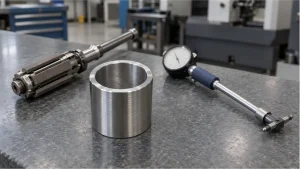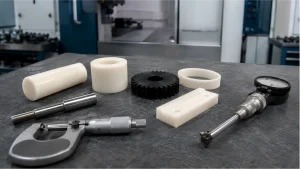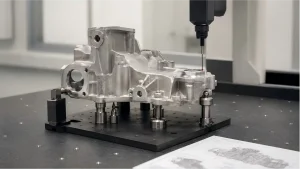

Delrin CNC machining is often easier to control than PTFE, nylon, or many soft plastics.
But that does not mean every Delrin part is simple.
Delrin, also commonly discussed as POM or acetal, is widely used for custom CNC machined plastic parts because it offers a practical balance of machinability, low friction, dimensional stability, wear behavior, and cost.
It is often used for:
- bushings
- rollers
- gears
- spacers
- wear pads
- sleeves
- sliders
- guide blocks
- valve parts
- fixture components
- electrical insulating parts
- low-friction mechanical parts
Delrin can machine cleanly, hold crisp edges, and produce good surface quality with the right process. However, it still needs proper review when the part has tight tolerances, thin walls, small threads, press fits, long bores, snap-fit features, sliding surfaces, or inspection requirements.
A good Delrin machining plan should review:
- exact material grade
- POM homopolymer or copolymer requirement
- stock form
- wall thickness
- bore and sleeve stability
- thread design
- sharp corner risk
- burr control
- moisture and temperature condition
- surface finish
- inspection method
- mating parts
- application load
- quantity and repeatability
The goal is not to make Delrin machining complicated.
The goal is to avoid treating Delrin like metal when the part function depends on plastic behavior.
What Is Delrin CNC Machining?
Delrin CNC machining is the process of cutting Delrin or POM stock into custom parts using CNC milling, CNC turning, drilling, boring, tapping, grooving, or secondary machining operations.
Buyers may use different terms in RFQs:
- Delrin parts
- Delrin machining
- CNC Delrin
- Delrin CNC machining
- POM CNC machining
- POM machining
- acetal machining
- acetal CNC parts
- POM bushings
- Delrin gears
- machined acetal components
In many RFQs, “Delrin” is used as a practical shorthand for acetal or POM plastic. However, the exact material grade still matters.
The drawing or RFQ should clarify whether the part requires:
- Delrin brand material
- POM homopolymer
- POM copolymer
- black POM
- natural white POM
- food-contact grade if required
- glass-filled, PTFE-filled, or modified grade if required
- material certificate if needed
Do not rely only on the word “Delrin” when the application has strict mechanical, chemical, food-contact, medical, or dimensional requirements.
For a broader engineering plastic comparison, see our Best Plastics for CNC Machining guide.
Why Delrin Is Popular for CNC Machined Parts
Delrin is popular because it machines cleanly and performs well in many mechanical applications.
Compared with softer plastics, Delrin usually offers better stiffness, cleaner chip formation, and more predictable feature control.
Compared with high-end plastics such as PEEK, Delrin is usually more cost-effective for moderate-temperature mechanical parts.
Compared with nylon, Delrin generally has lower moisture sensitivity, although humidity and application environment should still be reviewed.
Common reasons buyers choose Delrin include:
| Requirement | Why Delrin May Help |
|---|---|
| Low friction | Useful for sliding parts, bushings, rollers, and guides |
| Good machinability | Produces cleaner chips and sharper features than many softer plastics |
| Dimensional stability | Often more stable than nylon in many normal environments |
| Wear behavior | Useful for moving mechanical parts in selected applications |
| Electrical insulation | Suitable for many non-conductive mechanical components |
| Cost balance | More affordable than many high-performance plastics |
| Good surface quality | Can produce clean machined surfaces with proper tools |
| Stiffness | More rigid than PTFE and many soft plastics |
| Repeatability | Useful for prototype and low-volume mechanical parts |
Delrin is often a good starting point when a plastic part needs mechanical function but does not require the high temperature or chemical resistance of PEEK.
For material comparison against PEEK and POM, see our PEEK vs POM CNC machining guide.
When Delrin May Not Be the Best Choice
Delrin is useful, but it is not always the best plastic.
Before selecting Delrin, the buyer should review the real application conditions.
Delrin may need extra review when the part has:
- high service temperature
- continuous heavy load
- strong chemical exposure
- very tight press fits
- long-term creep risk
- ultra-low friction requirements
- high-wear abrasive contact
- thin snap-fit arms
- very small threads
- food, medical, or regulatory requirements
- low-outgassing requirements
- cleanroom or semiconductor requirements
- high moisture or outdoor exposure
- parts that must be bonded or painted
In some cases, PEEK, PTFE, nylon, PEI, PPS, UHMW, or another plastic may be more suitable.
For example:
| Requirement | Possible Better Material |
|---|---|
| Higher temperature and strength | PEEK |
| Very low friction and chemical resistance | PTFE |
| High impact and toughness | Nylon |
| Very low-cost prototype housing | ABS |
| Transparent part | Acrylic or polycarbonate |
| Higher chemical and thermal resistance | PEI, PPS, or PEEK depending on use |
Delrin should be chosen because its behavior matches the part function, not only because it is easy to machine.
Delrin vs POM vs Acetal: What Buyers Should Specify
Delrin, POM, and acetal are closely related terms, but they should not always be treated as identical in RFQs.
POM is the material family. Acetal is another common name for POM. Delrin is a well-known trade name often used for acetal homopolymer material.
In many standard CNC projects, buyers use these terms loosely. That may be acceptable for simple prototype parts, but it can create problems when the part has functional requirements.
The RFQ should specify:
| Material Item | Why It Matters |
|---|---|
| POM homopolymer or copolymer | Different grades may behave differently in strength, stability, and chemical resistance |
| Brand requirement | Some drawings require actual Delrin brand material |
| Color | Natural, black, or other color requirements may affect stock availability |
| Certificate need | Some projects require material traceability |
| Application condition | Temperature, load, wear, or chemical exposure may affect grade choice |
| Regulatory needs | Food-contact, medical, or industry requirements must be stated early |
| Filled grade | PTFE-filled, glass-filled, or modified grades may change machining behavior |
Buyers should also be aware of the internal structure difference between POM homopolymer and POM copolymer. Thick Delrin or POM-H rod stock may contain centerline porosity near the core of the material, depending on stock size and manufacturing method.
This may not matter for many standard bushings, rollers, spacers, gears, or non-pressure mechanical parts. However, it can become important when the part is used for fluid sealing, pressure-tight valve seats, manifold-style components, or features where internal leakage is not acceptable.
For pressure-sensitive or sealing-critical Delrin parts, the supplier may review POM copolymer, suitable stock size, stock orientation, machining position relative to the material core, or another material grade before production. If leakage risk is critical, the RFQ should clearly state the pressure, fluid, sealing requirement, and inspection method.
A better material note is:
Material: POM / acetal, black, supplier to confirm grade before production. Material certificate required if available.
If the exact grade is critical, the drawing should state it clearly.
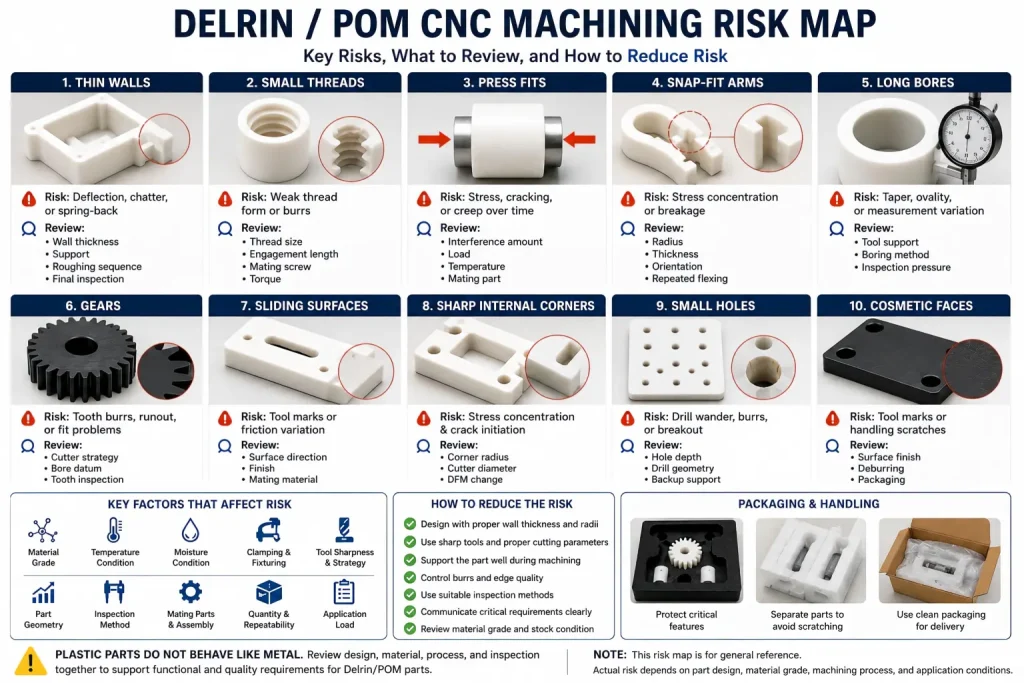
Delrin Machining Risk Map
Delrin machining risk usually appears in specific features rather than across the whole part.
| Feature | Main Risk | What to Review |
|---|---|---|
| Thin walls | Deflection, chatter, or spring-back | Wall thickness, support, roughing sequence, final inspection |
| Small threads | Weak thread form or burrs | Thread size, engagement length, mating screw, assembly torque |
| Press fits | Stress, cracking, or creep over time | Interference amount, load, temperature, mating part |
| Snap-fit arms | Stress concentration or breakage | Radius, thickness, orientation, repeated flexing |
| Long bores | Taper, ovality, or measurement variation | Tool support, boring method, inspection pressure |
| Gears | Tooth burrs, runout, or fit problems | Cutter strategy, bore datum, tooth inspection |
| Sliding surfaces | Tool marks or friction variation | Surface direction, finish, mating material |
| Sharp internal corners | Stress concentration | Corner radius, cutter diameter, DFM change |
| Small holes | Drill wander, burrs, or breakout | Hole depth, drill geometry, backup support |
| Cosmetic faces | Tool marks or handling scratches | Surface finish, deburring, packaging |
This risk map helps prevent a common RFQ mistake: assuming that clean machining automatically means every Delrin feature can hold metal-like tolerances.
Tolerance Planning for Delrin CNC Parts
Delrin can often hold good tolerances for a plastic material, but tolerance still depends on geometry and inspection condition.
A thick, compact Delrin part is usually easier to control than a thin, long, flexible, or heavily pocketed part.
Tolerance planning should review:
- part size
- material grade
- stock form
- wall thickness
- unsupported length
- machining sequence
- internal stress
- clamping method
- temperature condition
- moisture condition
- measurement method
- final application
- mating parts
- production quantity
Although Delrin is more dimensionally stable than many soft plastics, raw stock shapes can still contain residual internal stress from extrusion, molding, or stock manufacturing. When a machining setup removes a large amount of material from only one side of a plate, housing, or thick blank, the stress balance inside the part can change.
This can lead to slight bowing, flatness change, or shape movement after unclamping, especially on flat plates, deep pockets, thin covers, and asymmetrical parts.
For tight-tolerance Delrin parts, the supplier may review stress-relieved stock, balanced two-sided material removal, staged roughing and finishing, or a short stabilization period before final sizing. This helps reduce the chance that a part looks correct during machining but shifts before final inspection or assembly.
A drawing should not apply tight tolerance to every feature by default.
Instead, separate the part into:
- functional features
- sliding surfaces
- bearing bores
- clearance holes
- cosmetic edges
- non-critical outer profiles
- reference dimensions
- assembly-critical dimensions
- inspection-critical datums
This helps the supplier control cost and focus inspection effort where it matters.
For general tolerance planning, see our CNC machining tolerances guide.
Clamping and Fixturing for Delrin Parts
Delrin is stiffer than PTFE, but it can still move under clamping force.
If the fixture squeezes the part too hard, the machined dimension may change after the part is released.
Common fixturing risks include:
| Fixturing Issue | Possible Result |
|---|---|
| Excessive vise pressure | Size shift or slight distortion after unclamping |
| Small contact area | Local marks or dents |
| Poor support under pockets | Chatter or uneven wall thickness |
| Thin walls unsupported | Wall deflection during finishing |
| Hard jaws on cosmetic surfaces | Visible surface marks |
| Poor support during drilling | Exit burrs or breakout |
| Unbalanced material removal | Warping or flatness change |
For Delrin parts, the supplier may review soft jaws, custom fixtures, low clamping pressure, larger contact areas, and staged machining when required.
The fixture should match the part function.
A simple block may not need special fixturing. A thin-walled Delrin housing, long sleeve, or precision bushing may need more careful support.
CNC Milling Delrin Parts
CNC milling is commonly used for Delrin plates, blocks, housings, slots, pockets, covers, guides, fixtures, and custom mechanical parts.
Delrin usually mills well with sharp tools and a stable cutting strategy.
Milling review may include:
- cutter sharpness
- chip evacuation
- pocket depth
- corner radius
- wall height
- surface finish
- burr control
- thin feature support
- toolpath direction
- roughing and finishing allowance
- clamping contact areas
- final inspection condition
Delrin can produce clean surfaces, but dull tools, heat buildup, or poor chip removal can still create poor edges, smeared surfaces, or burrs.
For milled Delrin parts, deep pockets and thin walls should be reviewed before quotation.
For service capability, see our CNC milling services page.
CNC Turning Delrin Parts
CNC turning is often used for Delrin bushings, sleeves, rollers, rings, washers, spacers, shafts, and valve-style components.
Turning Delrin can produce clean round parts, but round features still need review.
Common turning risks include:
- jaw marks
- ovality
- taper
- bore size variation
- parting burrs
- thread burrs
- thin-wall distortion
- surface marks
- poor concentricity
- inspection variation
For Delrin sleeves and bushings, the supplier should review the relationship between outer diameter, inner diameter, wall thickness, and chucking method.
A thick bushing may be stable. A long thin sleeve may need soft jaws, support, light finishing cuts, or modified inspection planning.
For rotational custom parts, see our CNC turning services page.
Delrin Threads Need Design Review
Delrin can be threaded, but plastic threads should not always be treated like metal threads.
Thread strength depends on:
- thread size
- engagement length
- thread depth
- mating material
- assembly torque
- repeated assembly
- wall thickness around the thread
- insert requirement
- burr control
- inspection method
Possible Delrin thread issues include:
| Issue | Why It Happens |
|---|---|
| Weak internal thread | Short engagement or small thread size |
| Thread burrs | Dull tool, poor entry or exit control |
| Stripping | High torque or metal screw overload |
| Cross-threading | Soft material and poor starting alignment |
| Size change | Tapping pressure or material recovery |
| Cracking around boss | Thin boss wall or sharp internal corners |
| Gauge variation | Thread gauge force and plastic flexibility |
For repeated assembly, the supplier may review metal inserts, larger threads, longer engagement, or lower assembly torque.
A drawing note such as “M3 thread” may not be enough when the thread carries load or is assembled many times.
Delrin Bushings, Sleeves, and Sliding Parts
Delrin is commonly used for bushings and sliding parts because it has good low-friction behavior and useful wear properties in selected applications.
However, a Delrin bushing is not only a simple round part.
The supplier should review:
- bore diameter
- wall thickness
- length-to-diameter ratio
- mating shaft material
- clearance fit
- running speed
- load direction
- lubrication condition
- temperature
- expected wear
- inspection method
- surface direction
A tight bore tolerance may be reasonable for a thick, short bushing.
The same tolerance may be risky for a long, thin, unsupported sleeve.
For sliding parts, the drawing should define whether the surface is functional. Surface direction, tool marks, and burrs can affect friction and assembly behavior.
Gears and Precision Mechanical Features in Delrin
Delrin is often used for gears, cams, rollers, and precision mechanical parts.
These features need more review than simple plates.
For Delrin gears or moving components, the supplier may review:
- bore datum
- tooth form
- tooth burrs
- runout
- concentricity
- mating gear material
- backlash
- hub thickness
- shaft fit
- inspection method
- production quantity
- wear condition
A gear drawing should clearly identify which features control function.
The bore, tooth profile, and mating relationship may matter more than the outer cosmetic shape.
If a buyer only sends a 3D model without a 2D drawing, the supplier may not know which dimensions are critical.
Snap Fits and Flexible Features
Delrin can be used for clips, latches, and snap-fit parts, but these features need design review.
Snap-fit performance depends on:
- arm thickness
- root radius
- flex direction
- assembly force
- repeated use
- edge condition
- notch sensitivity
- material grade
- molding vs machining direction
- surface scratches
- operating temperature
Delrin can also be sensitive to sharp internal corners in bending, impact, or repeated assembly applications. A sharp milled corner can act as a stress riser, especially at the root of a snap-fit arm, internal pocket, latch, clip, or thin flexible feature.
For Delrin snap-fit arms and flexible features, the supplier should review internal corner radius, tool marks, edge condition, part orientation, and repeated assembly requirement. A larger internal fillet radius may help reduce local stress concentration and improve the chance of stable long-term use.
The goal is not to make every Delrin corner large. The goal is to avoid placing a sharp machined corner exactly where the part needs to flex or absorb load.
Machined snap-fit features may not behave exactly like molded snap fits.
A machined sharp internal corner can increase stress concentration. A burr or tool mark near the root may reduce reliability.
For snap-fit Delrin features, the drawing should define whether the feature is functional, how often it is assembled, and what load or deflection it must survive.
Moisture and Temperature Effects
Delrin generally absorbs less moisture than nylon, but it is not completely unaffected by environment.
For most normal CNC applications, Delrin is a relatively stable plastic. However, parts with tight dimensions, long storage, changing humidity, or precision fits may still need environmental review.
Temperature can also affect dimensions.
A Delrin part measured immediately after machining may not be in the same condition as the part during final use.
The supplier may review:
- inspection temperature
- cooling time after machining
- storage condition
- humidity exposure
- assembly environment
- operating temperature
- mating material expansion
This does not mean every Delrin part needs special conditioning.
It means tight-tolerance plastic parts should be reviewed under realistic use and inspection conditions.
Burrs and Edge Quality
Delrin usually cuts cleaner than many soft plastics, but burrs can still appear.
Burrs are common around:
- drilled holes
- milled slots
- thread starts
- thin edges
- gear teeth
- parting faces
- pocket exits
- small internal corners
Burr control depends on:
| Factor | Why It Matters |
|---|---|
| Tool sharpness | Dull tools push and smear plastic |
| Feed and speed | Poor cutting conditions can create rough edges |
| Drill exit support | Unsupported exits can break out or burr |
| Toolpath direction | Exit direction affects burr location |
| Edge radius | Sharp edges are more burr-sensitive |
| Deburring method | Aggressive deburring can damage functional edges |
| Surface requirement | Cosmetic or sliding surfaces need extra care |
A drawing should mark burr-sensitive edges when they affect assembly, sealing, sliding, or appearance.
For more on burr and edge quality, see our What Is Deburring? CNC Edge Quality, Burr Removal, and Inspection guide.
Surface Finish for Delrin CNC Parts
Delrin can produce good machined surfaces, but surface finish should still match the part function.
A surface finish requirement may be important for:
- sliding contact
- low-friction movement
- bushings
- gears
- guide surfaces
- cosmetic faces
- sealing or contact faces
- visible customer-facing parts
Surface finish depends on:
- tool sharpness
- feed rate
- cutter path
- tool marks
- material grade
- clamping stability
- chip control
- post-machining handling
- inspection standard
A note that only says “smooth finish” may not be enough.
Better drawing notes may say:
- which surfaces are visible
- which surfaces are sliding
- whether tool marks are acceptable
- whether Ra value is required
- whether scratches are allowed
- whether deburring must avoid rounding a functional edge
For broader finish planning, see our CNC surface finishes guide.
Inspection Challenges for Delrin CNC Parts
Delrin inspection is usually easier than PTFE inspection, but it still needs proper planning.
Plastic parts can be affected by:
- measurement force
- part support
- temperature
- humidity
- clamping history
- thin-wall flexibility
- thread gauge force
- bore gauge pressure
- datum selection
- cosmetic surface handling
Inspection should focus on function.
A CMM report may be useful for some Delrin parts, but not every feature needs CMM inspection.
For critical Delrin parts, define:
| Feature | Inspection Review |
|---|---|
| Precision bore | Bore gauge method, roundness, and inspection pressure |
| Gear bore | Concentricity, runout, and datum |
| Sliding surface | Surface finish, burrs, and flatness |
| Thread | Gauge method and assembly check |
| Thin wall | Final inspection after unclamping |
| Snap feature | Visual check and functional fit |
| Critical hole pattern | Datum references and position tolerance |
| Cosmetic surface | Visual standard and handling marks |
For inspection planning, see our CMM inspection for CNC parts guide.
Delrin vs PTFE, Nylon, and PEEK
Delrin is often compared with PTFE, nylon, and PEEK because all four are common engineering plastics.
| Material | Main Strength | Main Risk |
|---|---|---|
| Delrin / POM | Good machinability, low friction, dimensional stability | Grade confusion, burrs, threads, press fits, and temperature effects |
| PTFE | Very low friction, chemical resistance, sealing, insulation | Low stiffness, creep, clamping deformation, and inspection variation |
| Nylon | Toughness, impact resistance, wear behavior | Moisture absorption and dimensional change |
| PEEK | High temperature, strength, chemical resistance, premium performance | High material cost, tool wear, grade-specific behavior |
Delrin is often a strong choice for mechanical plastic parts when the application does not require extreme temperature, chemical resistance, or ultra-low friction.
PTFE may be better for low-friction sealing and chemical resistance.
PEEK may be better for high-temperature and high-performance applications.
Nylon may be better for impact and toughness, depending on moisture and application conditions.
The best material depends on geometry, load, temperature, chemical exposure, wear, inspection, and cost target.
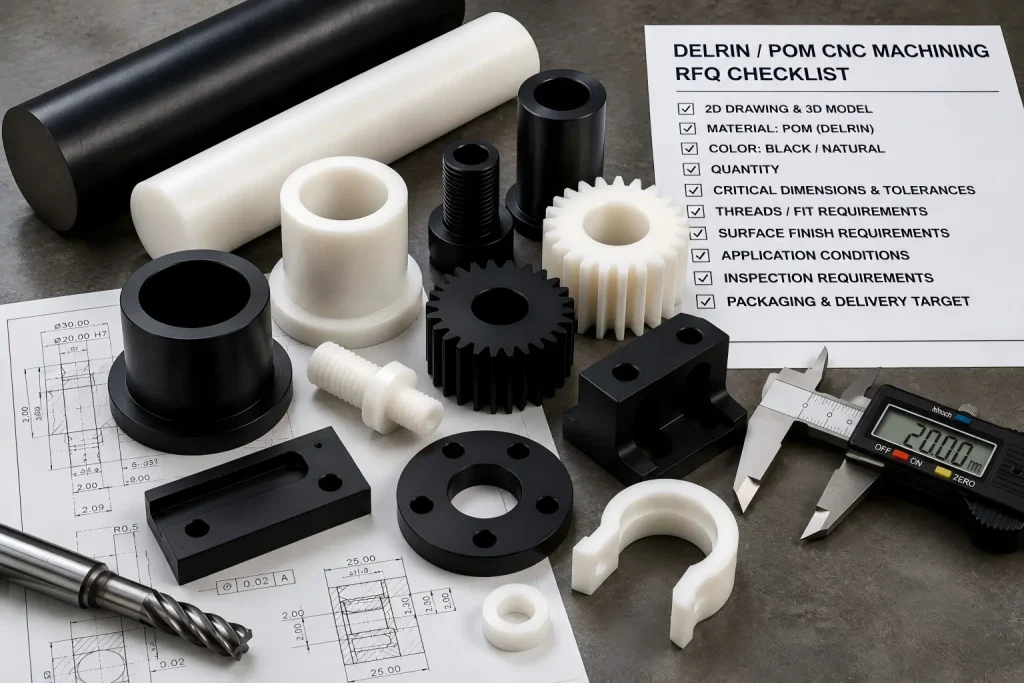
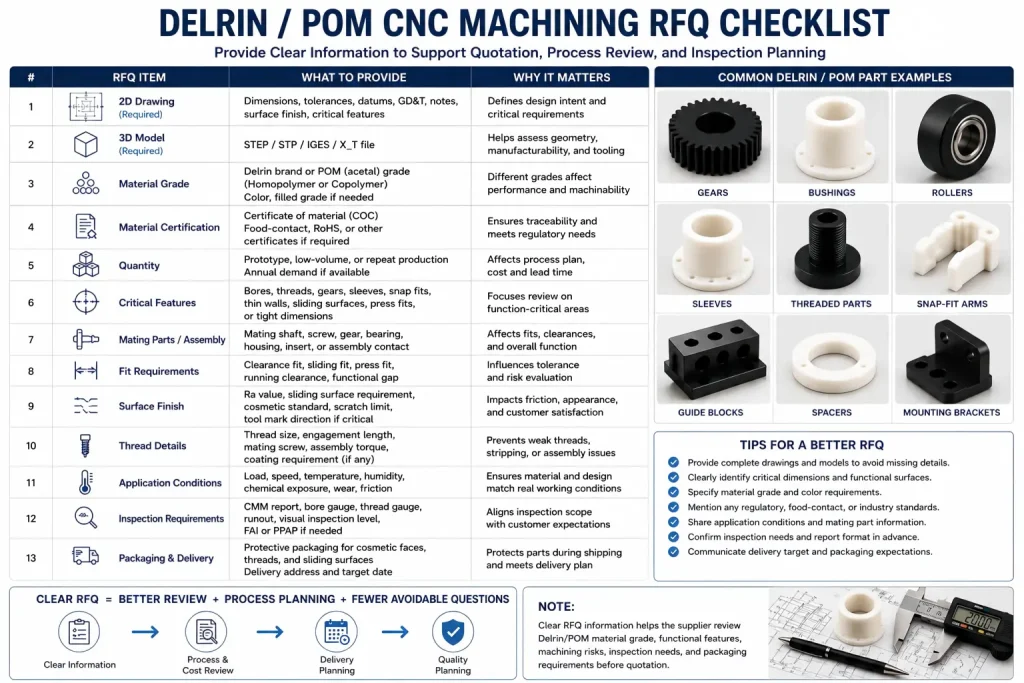
RFQ Checklist for Delrin CNC Machining
Before requesting a Delrin CNC machining quote, provide information that helps the supplier review material, tolerance, machining route, and inspection risk.
| RFQ Item | What to Provide |
|---|---|
| 2D drawing | Dimensions, tolerances, datums, notes, surface finish, and critical features |
| 3D model | STEP / STP / IGES / X_T file |
| Material grade | Delrin, POM homopolymer, POM copolymer, acetal, color, and certificate needs |
| Quantity | Prototype, low-volume batch, or repeat production |
| Critical features | Bores, threads, gears, sleeves, snap fits, sliding surfaces, or thin walls |
| Mating parts | Shaft, screw, gear, bearing, housing, insert, or assembly contact |
| Fit requirement | Clearance fit, sliding fit, press fit, running clearance, or functional gap |
| Surface finish | Ra value, sliding surface requirement, cosmetic standard, or scratch limit |
| Thread requirement | Thread size, engagement length, mating screw, and assembly torque if known |
| Application condition | Load, speed, temperature, humidity, wear, friction, or chemical exposure |
| Inspection requirement | CMM, bore gauge, thread gauge, runout check, visual inspection, or report |
| Packaging need | Protection for cosmetic faces, gears, threads, and sliding surfaces |
| Delivery target | Helps review process route, inspection timing, and production planning |
A good RFQ does not only say “Delrin part.”
It explains which features must function correctly after machining, inspection, shipping, and assembly.
Practical Drawing Notes for Delrin Parts
Example 1: Precision Bushing
Bore is functional sliding surface. Supplier to review bore size, roundness, inspection pressure, and mating shaft fit before production.
This is better than only marking a tight bore tolerance.
Example 2: Delrin Thread
Internal thread is used for repeated assembly. Supplier to review engagement length, mating screw, burr control, and assembly torque before machining.
This helps prevent treating plastic threads like metal threads.
Example 3: Gear Feature
Gear bore is datum-critical. Supplier to review bore-to-tooth relationship, runout, burr control, and inspection method.
This helps protect functional motion.
Example 4: Snap-Fit Arm
Snap-fit feature is functional. Supplier to review root radius, tool marks, edge condition, and repeated assembly requirement.
This reduces risk around sharp internal corners and stress concentration.
Example 5: Sliding Surface
Marked face is sliding surface. Supplier to review surface direction, tool marks, burrs, and mating material before production.
This connects surface finish with the real part function.
Packaging and Handling for Delrin Machined Parts
Delrin is tougher than PTFE, but packaging still matters when the part has functional or cosmetic surfaces.
Packaging should be reviewed when the part has:
- gears
- threads
- polished faces
- cosmetic surfaces
- precision bores
- sliding surfaces
- snap-fit arms
- thin edges
- clean assembly requirements
Possible packaging steps include:
- individual wrapping
- soft separators
- avoiding heavy stacking
- protecting thin features
- separating metal and plastic parts
- keeping burr-sensitive parts separated
- protecting visible surfaces
- labeling critical faces if needed
Packaging does not improve machining quality, but it helps protect the condition achieved during machining and inspection.
Rapid Efficient Support for Delrin CNC Machining
Rapid Efficient can review custom Delrin and POM CNC machined parts according to material grade, geometry, tolerance, surface requirement, and inspection needs.
We can review:
- Delrin or POM material requirement
- CNC milling or turning route
- bore and sleeve stability
- thread design
- gear or sliding feature risk
- snap-fit geometry
- thin-wall features
- burr control
- surface finish
- inspection method
- packaging needs
- prototype or low-volume production plan
For broader custom part manufacturing, see our CNC machining services page.
If your Delrin part has threads, bushings, gears, sliding surfaces, snap-fit arms, or tight-tolerance bores, send the 2D drawing, 3D model, material grade, quantity, and application notes before quotation. We can review the part and suggest a suitable machining route.
Buyer Questions About Delrin CNC Machining
Is Delrin easy to CNC machine?
Delrin usually machines cleanly and is often easier to control than many softer plastics. However, thin walls, small threads, press fits, snap fits, burrs, and inspection requirements still need review.
Is Delrin the same as POM?
Delrin is commonly used as a trade name for acetal/POM material, but buyers should not assume every POM grade is identical. The RFQ should specify whether Delrin brand material, POM homopolymer, POM copolymer, color, or certification is required.
Can Delrin hold tight tolerances?
Delrin can hold good tolerances for suitable plastic part features, but tolerance depends on geometry, wall thickness, material grade, clamping, temperature, moisture condition, machining strategy, and inspection method.
Can Delrin parts have threads?
Yes, Delrin parts can have threads. Thread size, engagement length, mating screw, assembly torque, and repeated assembly should be reviewed. Some designs may need inserts or larger thread engagement.
Is Delrin good for bushings and gears?
Delrin is often used for bushings, gears, rollers, and sliding parts because it has useful low-friction and wear behavior. Bore stability, runout, burr control, surface finish, and mating material should still be reviewed.
What files should I send for Delrin CNC machining?
Send a 2D drawing, 3D model, material grade, color, quantity, critical features, tolerance notes, surface finish requirements, mating parts, application conditions, inspection needs, and packaging requirements.