
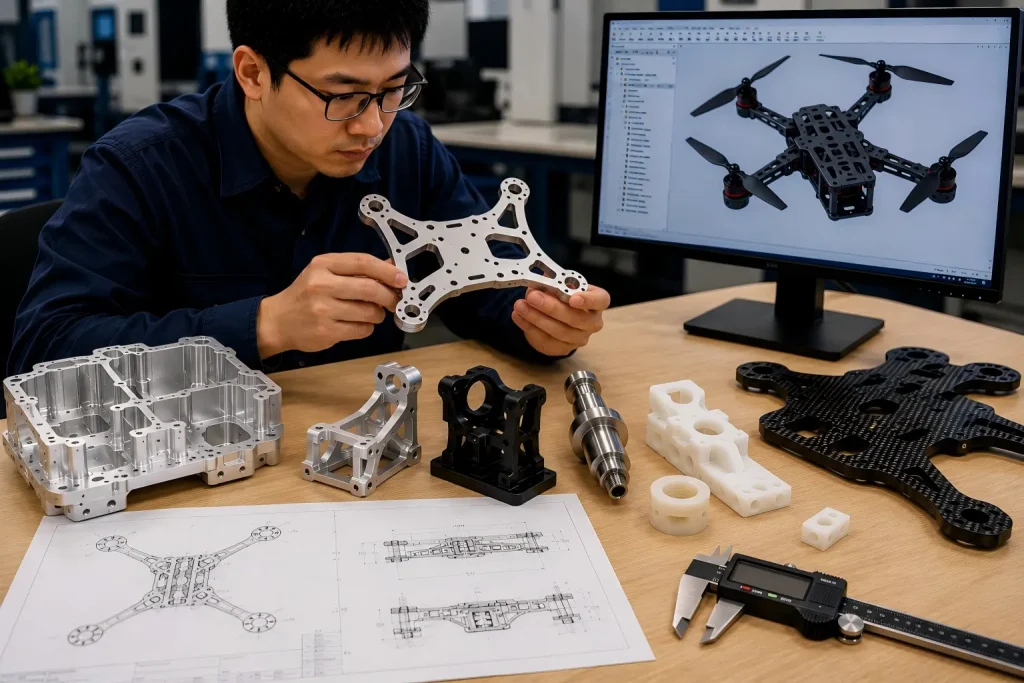
Material selection affects much more than the finished weight of a drone component.
The material also influences stiffness, fatigue resistance, vibration, thread strength, corrosion, heat transfer, surface treatment, machining time, inspection, and total finished-part cost.
A lighter material does not automatically produce a lighter or stronger drone. Geometry, wall thickness, ribs, fastener locations, unsupported span, and the connection between components can matter as much as the material grade.
For CNC-machined drone parts, the best material depends on the function of the component rather than one universal ranking.
Quick Answer
The five most practical material options for CNC-machined drone parts are:
- 6061-T6 or 6061-T651 aluminum for general frames, housings, brackets, plates, motor mounts, heat sinks, and prototypes.
- 7075-T6 or 7075-T651 aluminum for compact, highly loaded brackets, structural links, and components where higher strength creates a real weight benefit.
- Ti-6Al-4V titanium for selected high-load connectors, fasteners, shafts, and interfaces where aluminum is no longer sufficient.
- 17-4PH stainless steel for shafts, pins, wear interfaces, fasteners, and compact load-bearing parts requiring strength and corrosion resistance.
- POM or PEEK engineering plastics for insulators, bushings, guides, covers, cable-management parts, and lightweight nonmetal components.
Carbon-fiber composite is also widely used in drone structures, but it requires a different manufacturing and machining strategy from aluminum, titanium, steel, or plastic stock.
The final choice should consider:
- Required load
- Stiffness
- Fatigue and vibration
- Maximum weight
- Operating temperature
- Corrosion exposure
- Electrical or thermal requirements
- Threads and assembly cycles
- Surface finish
- Quantity
- Material availability
- Finished-part cost
Quick Material Comparison
| Material | Main advantage | Main limitation | Typical CNC drone parts |
|---|---|---|---|
| 6061-T6 / T651 aluminum | Practical balance of weight, machining, corrosion resistance, anodizing, availability, and cost | Lower strength than 7075 and steel | Housings, brackets, motor mounts, plates, frames, heat sinks |
| 7075-T6 / T651 aluminum | High strength-to-weight performance | Higher cost, more corrosion and finishing control, limited welding | High-load brackets, structural links, compact mounts |
| Ti-6Al-4V titanium | High strength at relatively low density with good corrosion resistance | High material and machining cost, heat and tool-wear control | High-load connectors, fasteners, shafts, compact interfaces |
| 17-4PH stainless steel | High strength and hardness with useful corrosion resistance | Much heavier than aluminum and dependent on heat-treatment condition | Pins, shafts, fasteners, wear parts, transmission interfaces |
| POM / PEEK | Lightweight, nonconductive options with useful machining properties | Lower stiffness than metals; temperature, creep, and grade selection matter | Bushings, guides, covers, insulators, cable and sensor parts |
| Carbon-fiber composite | Very high stiffness-to-weight potential in the designed fiber direction | Delamination, dust, edge quality, joining, and fiber orientation require separate planning | Arms, plates, shells, frames, propeller-related structures |
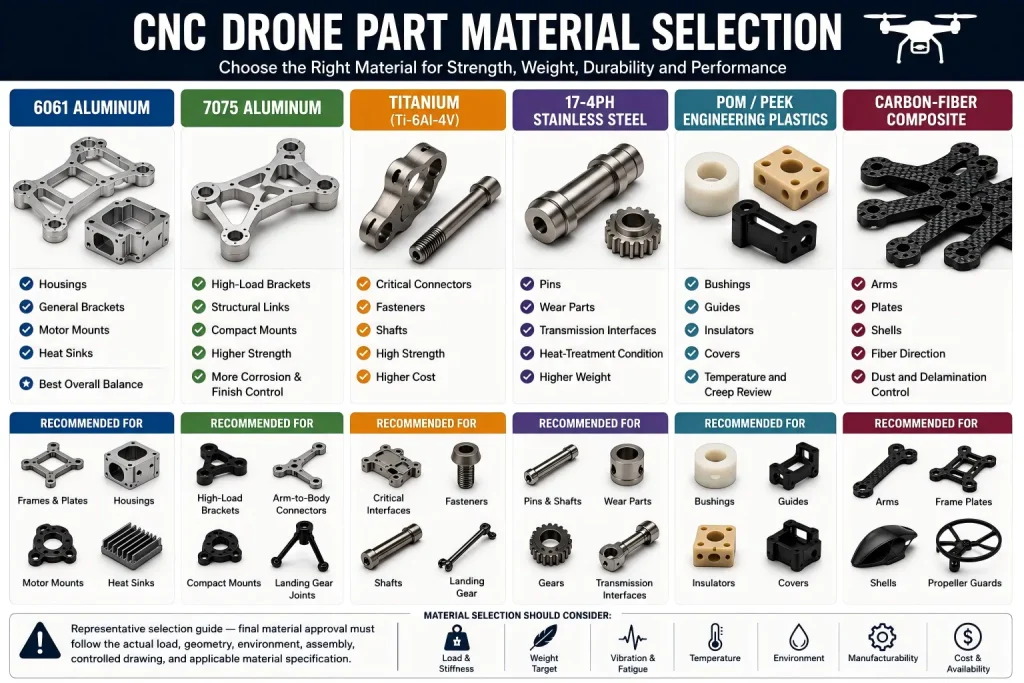
This table is a starting point. The final drawing should specify the exact grade, temper or condition, stock form, surface treatment, and inspection requirements.
1. 6061 Aluminum for General Drone Components
6061-T6 and 6061-T651 are practical starting materials for many CNC-machined drone parts.
Common applications include:
- Motor mounts
- Camera brackets
- Controller housings
- Battery enclosures
- Structural plates
- Sensor mounts
- Heat sinks
- Landing-gear brackets
- Prototype frames
- Payload interfaces
6061 offers a useful combination of:
- Moderate structural strength
- Low density
- General corrosion resistance
- Broad material availability
- Welding options
- Anodizing and coating options
- Thermal conductivity
- Reasonable finished-part cost
It is often the better choice when the component does not require the additional strength of 7075.
CNC Machining Considerations
6061 can be milled, drilled, tapped, and turned successfully, but it should not be treated as completely problem-free.
Depending on the operation, it may produce:
- Long chips
- Built-up edge
- Burrs
- Scratched surfaces
- Chips packed into deep holes
- Thin-wall distortion
Sharp tools, stable workholding, controlled tool runout, suitable chip evacuation, and a planned finishing allowance still matter.
For a detailed comparison of the two most common high-strength drone aluminum options, review 6061 vs 7075 aluminum for CNC machining.
2. 7075 Aluminum for High-Load Lightweight Parts
7075-T6 and 7075-T651 provide substantially higher strength and hardness than common 6061-T6 or T651 products.
They may be appropriate for:
- Highly loaded motor mounts
- Compact structural joints
- Arm-to-body connectors
- High-load camera or payload mounts
- Landing-gear connection parts
- Lightweight linkages
- Critical brackets
- Components where reducing section size provides a real weight benefit
7075 is not automatically the better drone material.
Its higher strength is useful only when the geometry, load, or safety factor can take advantage of it. Replacing 6061 with 7075 without changing the design may increase cost without producing a proportional improvement in stiffness.
Important Trade-Offs
Compared with 6061, 7075 may require more attention to:
- Material cost
- Corrosion exposure
- Stress-corrosion conditions
- Protective finishing
- Material certification
- Stock availability
- Anodized color variation
- Welding limitations
- Scrap risk
Both 6061 and 7075 can be machined into clean precision components under a stable process. Neither alloy automatically guarantees better tolerance, surface finish, or dimensional stability.
Kaiser’s official material data supports the broad distinction: 6061 provides a strong general combination of corrosion resistance, finishing and manufacturing flexibility, while 7075 provides much higher strength with additional corrosion and processing considerations.
3. Ti-6Al-4V Titanium for Selected Critical Interfaces
Ti-6Al-4V, commonly called Grade 5 titanium, may be considered when a compact drone component requires higher load capacity than aluminum can provide while weight remains important.
Possible applications include:
- High-load connectors
- Critical fasteners
- Compact shafts
- Pivot components
- Payload attachment interfaces
- Landing-gear joints
- Wear-sensitive mounting features
- Parts exposed to corrosive environments
Titanium should not be selected only because it sounds more advanced.
Its higher material price and longer machining time must produce a meaningful functional benefit.
CNC Machining Considerations
Titanium has low thermal conductivity, so cutting heat tends to remain near the cutting edge.
The process may require:
- Rigid workholding
- Short tool overhang
- Suitable cutting speeds
- Controlled tool engagement
- Sharp, stable cutting edges
- Effective coolant delivery
- Tool-wear monitoring
- Conservative finishing passes
Titanium is strong, but its elastic stiffness is lower than steel. Part geometry still controls much of the actual deflection and vibration response. TIMET describes titanium alloys as combining low density, high strength and corrosion resistance, while also noting that titanium stiffness is substantially lower than steel.
4. 17-4PH Stainless Steel for Shafts, Pins, and Wear Parts
17-4PH is a precipitation-hardening stainless steel used where compact size, high strength, hardness, and useful corrosion resistance are required.
Possible drone applications include:
- Shafts
- Pins
- Threaded inserts
- High-load fasteners
- Wear interfaces
- Transmission components
- Pivot features
- Retaining hardware
- Compact support blocks
The heat-treatment condition must be specified.
Writing only 17-4PH may leave the required strength, hardness, toughness, and final machining sequence unclear.
Manufacturing Considerations
The supplier should review:
- Material condition before machining
- Final aging or heat-treatment condition
- Grinding allowance where required
- Distortion risk
- Thread requirements
- Surface finish
- Passivation or cleaning
- Final inspection condition
17-4PH is much heavier than aluminum or titanium. It is most useful in small, highly loaded features rather than large drone frames or covers.
Carpenter Technology describes 17-4PH as a precipitation-hardening stainless steel that combines high strength and hardness with useful corrosion resistance; its final property balance depends on the selected aging treatment.
5. POM and PEEK Engineering Plastics
Engineering plastics can reduce weight, provide electrical insulation, and simplify components that do not require metallic stiffness.
However, POM, PEEK, nylon, PTFE, and ABS should not be grouped as if they have identical properties.
POM
POM, also called acetal, is often useful for:
- Bushings
- Cable guides
- Sensor mounts
- Sliding components
- Lightweight brackets
- Covers
- Adjustment blocks
- Nonconductive locating parts
Its advantages include:
- Good machinability
- Dimensional stability
- Low moisture absorption
- Useful fatigue behavior
- Low friction
- Good wear performance
Ensinger identifies dimensional stability, fatigue strength and machinability as important POM characteristics.
PEEK
PEEK is a higher-cost material considered where the project requires:
- Higher operating temperature
- Better long-term creep performance
- Chemical resistance
- Higher mechanical performance than common plastics
- Electrical insulation
- Low weight
- Wear resistance
Possible drone applications include:
- High-temperature sensor components
- Electrical isolation parts
- Bushings
- Specialized cable guides
- Lightweight wear components
- Components near motors or electronics
PEEK is not automatically necessary for every drone plastic part. Its material cost should be justified by temperature, chemical, wear, or mechanical requirements. Victrex describes PEEK as a high-performance thermoplastic with strong mechanical, creep, fatigue, temperature and chemical-resistance characteristics.
For a broader comparison of POM, nylon, PTFE and PEEK, review our best plastics for CNC machining.
Where Carbon-Fiber Composite Fits
Carbon-fiber-reinforced polymer is widely used in drone frames, arms, plates, shells, and propeller-related structures because fiber orientation can provide high stiffness at low weight.
It should not be treated as a direct metal replacement.
Carbon-fiber composite performance depends on:
- Fiber direction
- Number of layers
- Layup sequence
- Resin system
- Cure quality
- Hole position
- Edge distance
- Insert design
- Load direction
- Impact exposure
Machining and Safety Considerations
Composite trimming, routing and drilling may require:
- Carbide or diamond-coated tooling
- Controlled tool entry and exit
- Backing support
- Delamination control
- Fiber-pullout control
- Dust extraction
- Edge sealing
- Suitable personal protection
- Inspection for cracking or layer separation
The carbon fibers can also be electrically conductive, which may affect electronics, grounding and galvanic interaction with aluminum components.
OSHA notes that advanced composites can combine high strength, high stiffness, low weight and corrosion resistance, while carbon-fiber handling still requires attention to dust and mechanical irritation.
Which Material Fits Each Drone Part?
| Drone part | Practical starting material | Why | Main risk to review |
|---|---|---|---|
| General motor mount | 6061-T6 / T651 | Good balance of weight, machining, corrosion and cost | Thread life, vibration, heat transfer |
| High-load motor mount | 7075-T6 / T651 | Higher strength in a compact design | Corrosion protection and anodizing |
| Frame or controller housing | 6061 aluminum | Practical machining and finishing | Thin-wall deformation and sealing |
| Structural arm or plate | 6061, 7075 or carbon fiber | Choice depends on stiffness, load and quantity | Vibration, fatigue, joining and tool access |
| Shaft or pivot pin | 17-4PH or titanium | Compact strength and wear performance | Heat treatment, runout and surface finish |
| High-load lightweight connector | Titanium or 7075 | High strength-to-weight potential | Cost and machining time |
| Cable guide or bushing | POM | Low weight, good machining and sliding performance | Creep, temperature and clamping |
| High-temperature insulator | PEEK | Temperature and chemical resistance | Material cost and thermal expansion |
| Heat sink or cooling plate | 6061 aluminum | Useful thermal performance and machining | Contact flatness and airflow |
| Landing-gear bracket | 6061, 7075 or titanium | Depends on impact load and weight target | Fatigue, fastener load and service damage |
Strength and Stiffness Are Not the Same
Material strength defines how much stress a material can withstand before permanent deformation or failure.
Stiffness describes how much the component elastically deflects under load.
A stronger material does not always make a same-size part dramatically stiffer.
For example, 7075 is much stronger than 6061, but their elastic moduli are relatively close. A meaningful stiffness or weight improvement may therefore require a geometry change rather than only a material substitution.
Drone components should be reviewed for:
- Arm bending
- Motor vibration
- Camera stability
- Joint deflection
- Fastener preload
- Landing impact
- Fatigue cycles
- Resonance
- Unsupported span
Threads and Repeated Assembly
Drone prototypes are often assembled, adjusted and disassembled many times.
Small tapped holes in aluminum or plastic may wear or strip during repeated service.
The design should consider:
- Thread size
- Engagement depth
- Tightening torque
- Assembly frequency
- Local wall thickness
- Insert material
- Access for installation
- Replaceability
Possible options include:
- Longer thread engagement
- Threaded inserts
- Through-bolts
- Steel nuts
- Replaceable bushings
- Larger local bosses
The strongest base material is not always necessary if a replaceable insert can protect the functional thread.
Surface Treatment and Galvanic Corrosion
Drone assemblies may combine:
- Aluminum
- Stainless steel fasteners
- Titanium
- Carbon fiber
- Copper
- Conductive coatings
When dissimilar conductive materials contact each other in moisture or salt exposure, galvanic corrosion may occur.
The design may require:
- Anodizing
- Conversion coating
- Paint
- Plating
- Isolation washers
- Sealants
- Controlled drainage
- Masked electrical contact areas
- Approved fastener combinations
Bearing fits, threads, grounding areas, thermal-contact faces and sealing surfaces may require masking or dimensional allowance.
Review available surface finishes for CNC machined parts before finalizing the drawing.
Prototype and Production Quantity
Material and manufacturing choices may change as the drone moves from prototype to production.
Prototype and Engineering Validation
CNC machining is useful for:
- Fast design changes
- Low quantities
- Functional metal parts
- Accurate motor and sensor interfaces
- Direct comparison with CAD
- Testing multiple materials
Higher Quantities
At higher volumes, some parts may move to:
- Aluminum extrusion plus CNC finishing
- Die casting plus CNC finishing
- Sheet-metal fabrication
- Injection molding
- Molded composite structures
- Standard profiles with machined interfaces
Critical mounting faces, holes, bearing seats and threaded features may still require CNC finishing.
RFQ Checklist for CNC Drone Parts
Provide the following information before quotation:
- 3D CAD model
- Controlled 2D drawing
- Material grade
- Temper or heat-treatment condition
- Stock form
- Prototype or production quantity
- Maximum part weight
- Load and vibration requirements
- Critical dimensions and datums
- Threads and assembly cycles
- Mating-component information
- Surface finish
- Anodizing, coating or passivation
- Masked areas
- Electrical or thermal requirements
- Inspection-report requirements
- Material-certificate requirements
- Packaging requirements
These details allow the supplier to evaluate material, wall thickness, tool access, workholding, finishing, inspection and total cost before machining.
How Rapid Efficient Supports Drone Part Projects
Rapid Efficient supports custom metal and engineering-plastic components for drone prototypes, engineering validation, low-volume production and repeat orders.
Project support may include:
- Drawing and manufacturability review
- Material and stock-form review
- CNC milling and turning
- Multi-axis process planning
- Lightweight brackets and housings
- Motor, sensor and payload mounting parts
- Thin-wall machining review
- Thread and insert planning
- Surface-finishing coordination
- Dimensional inspection
- CMM reports when requested
- Material documentation when requested
- Packaging and international delivery coordination
Final feasibility depends on part size, material, geometry, quantity, tolerances, finish, inspection and documentation requirements.
Learn more about our CNC aluminum machining services.
Rapid Efficient can review complete drawings, models, quantities and project requirements and typically provide quotation feedback within 24 hours.
FAQ
What is the best aluminum for CNC drone parts?
6061-T6 or T651 is the practical starting point for many housings, brackets, motor mounts and plates. 7075-T6 or T651 is more appropriate when substantially higher strength creates a useful weight or section-size benefit.
Is 7075 always better than 6061 for drones?
No. 7075 is stronger, but it usually costs more and requires more attention to corrosion, welding and surface finishing. Many general drone components do not benefit from the additional strength.
Is titanium lighter than aluminum?
No. Titanium is denser than aluminum, although it provides much higher strength. It may reduce total component weight only when the design can use a smaller or thinner section.
Which plastic is best for CNC drone parts?
POM is practical for bushings, guides, covers and general nonmetal components. PEEK is considered when higher temperature, chemical resistance, creep performance or mechanical performance is required.
Can carbon fiber be CNC machined?
Yes, carbon-fiber composite can be drilled, routed and trimmed, but it requires composite-specific tooling, dust extraction, delamination control and inspection. Its machining route differs from conventional metal CNC machining.
What material is best for drone shafts and pins?
17-4PH stainless steel or titanium may be considered, depending on load, wear, corrosion, diameter, weight and cost. Heat treatment and final surface requirements should be specified.
Should drone aluminum parts be anodized?
Anodizing may improve corrosion resistance, wear behavior and appearance, but the need depends on alloy, environment, electrical grounding, threads, bearing fits and assembly requirements.
What files are needed for a drone-part quotation?
Provide a 3D model, controlled 2D drawing, material, quantity, load requirements, critical tolerances, surface treatment, assembly information and inspection requirements.
Request a Drone Part Material Review
Send Rapid Efficient your 2D drawing, 3D model, material preference, quantity, target weight, load requirements, surface finish and inspection expectations.
We can review:
- 6061 versus 7075
- Aluminum versus titanium or steel
- Metal versus engineering plastic
- Thin-wall and weight-reduction risks
- Threads and inserts
- Surface-treatment allowances
- Galvanic-corrosion risks
- Critical tolerances
- Inspection and documentation scope
Selecting the material together with the geometry and manufacturing route can reduce unnecessary weight, material cost, machining time and assembly risk.