“Black oxide, all over” leaves a supplier with several unanswered questions. Will the part stay oiled in service? Will an assembly wash remove that oil? Does a close-fitting bore have to meet its tolerance after finishing?
Those details matter because the black surface and the corrosion protection are not the same requirement.
Black oxide coating is a thin conversion finish used on suitable steel parts for a dark appearance with little dimensional buildup. Conventional hot black oxide forms magnetite, an iron oxide. Its corrosion protection is limited, so the specified oil, wax, or other post-treatment is often a key part of the finish.
For machined components, select the blackening process, protective treatment, and final inspection condition together.
Decide What Will Stay on the Part After Cleaning
Start with the last cleaning step before assembly.
An oil-sealed component may leave the finishing supplier with suitable protection for its intended storage conditions. If the buyer later removes the oil, the black appearance can remain while the protection changes.
The black finish helps hold the sealant against the metal, while the sealant provides much of the corrosion resistance, as described in Birchwood Technologies’ black oxide guide. Cleaning compatibility therefore belongs in the finish specification.
Use the expected condition in service to guide the discussion:
| Condition after assembly | Finish decision | Detail to resolve before approval |
|---|---|---|
| An indoor mechanism can retain a light protective oil | Review black oxide with an approved oil | Oil compatibility, handling, and maintenance access |
| A handled part must feel dry | Review a suitable dry-to-touch post-treatment | Residue transfer, appearance, and protection after handling |
| A part will be degreased before bonding or clean assembly | Evaluate the part after that cleaning operation | Whether the protective film is removed and how the exposed finish will be protected |
| A close-fitting shaft or bore has little clearance | Review the complete finish and post-treatment at the interface | Film residue, final dimensions, and the permitted assembly lubricant |
| A part faces repeated washdown, condensation, or outdoor exposure | Compare other finish systems before committing | Required corrosion performance, cleaning chemicals, and maintenance |
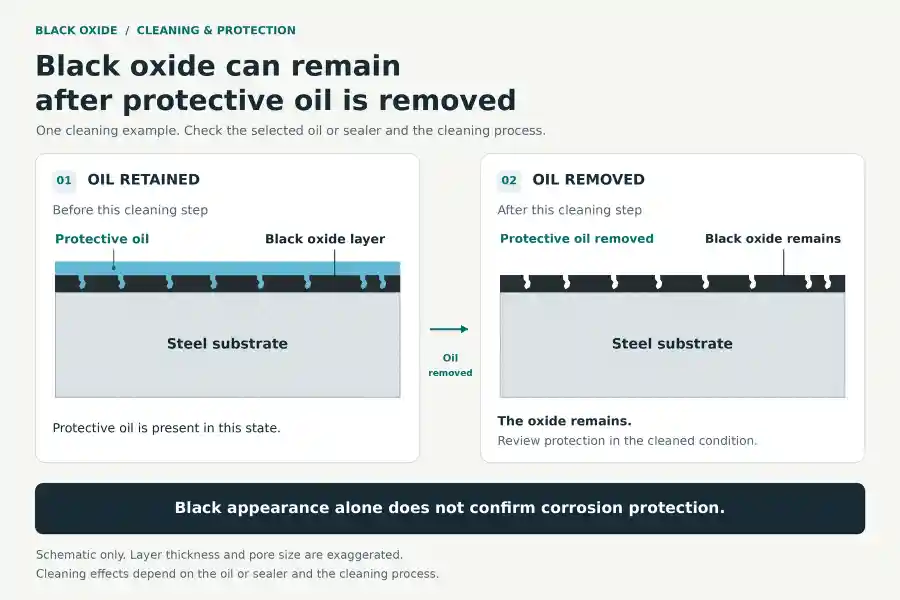
A dry-to-touch surface is not necessarily free of oil, wax, or another film. If residue matters for bonding, optics, or clean assembly, define an acceptance requirement that addresses that use.
Likewise, a salt-spray result for one blackening and sealing system is not a universal rating for all black oxide parts. Agree on the substrate, process, post-treatment, test condition, and acceptance criteria. Test hours should not be presented as a direct prediction of service life.
If the required environment exceeds what the selected system can support, use the broader surface finishes for CNC-machined parts guide to compare alternatives.
Hot, Mid-Temperature, and Cold Blackening Are Not Interchangeable
The term “black oxide” is used loosely in quotations. A similar color does not prove that two suppliers propose the same coating.
Conventional hot black oxide on suitable steel forms a magnetite conversion layer. Some commercial mid-temperature processes also produce magnetite. Common room-temperature blackening systems instead deposit a copper–selenium compound. EPi’s blackening process FAQ distinguishes its room-temperature process from true black oxide.
That distinction affects how an alternative process should be approved.
If the drawing calls for a specified black oxide treatment, a room-temperature blackening product is not automatically an acceptable substitute. The proposed route must meet the drawing and purchasing requirements, including any limits on chemistry, durability, appearance, and post-treatment.
A bath-temperature label alone does not show that a process meets a particular specification class. Ask for the actual process designation and supporting documentation.
For repeat orders, record the approved route. “Same black color” is too weak a basis for accepting a process change.
Check Close Fits After Finishing
Black oxide can suit close-fitting steel parts because it adds little dimensional buildup. Surface preparation and the selected sealer still need review because they can affect the final fit.
Separate three effects.
Surface preparation can change the starting geometry
Scale, rust, and machining residue must be addressed before coating. The proposed cleaning or descaling method must also respect the part’s geometry.
Ask whether blasting, aggressive chemical treatment, or polishing is planned. A precision seat, sharp locating edge, or sealing surface should not receive an unreviewed preparation step simply because the final coating is thin.
Blackening also does not fill scratches, remove burrs, or correct an out-of-tolerance bore. Those conditions belong to the incoming-part requirements.
The conversion layer is not a generic machining allowance
Do not apply one published coating-thickness number as an automatic offset to every shaft and bore.
The process, substrate, preparation, and tolerance budget determine whether compensation is necessary. For a critical fit, agree on the final requirement and verify the selected finishing route on representative geometry.
The practical question is whether the finished feature meets the drawing, not whether a brochure describes the coating as “non-dimensional.”
The post-treatment has its own surface condition
Oil, wax, and dry-film sealers leave different surface conditions. Residue in a small bore or on a sliding interface may matter even when the conversion layer itself causes little dimensional change.
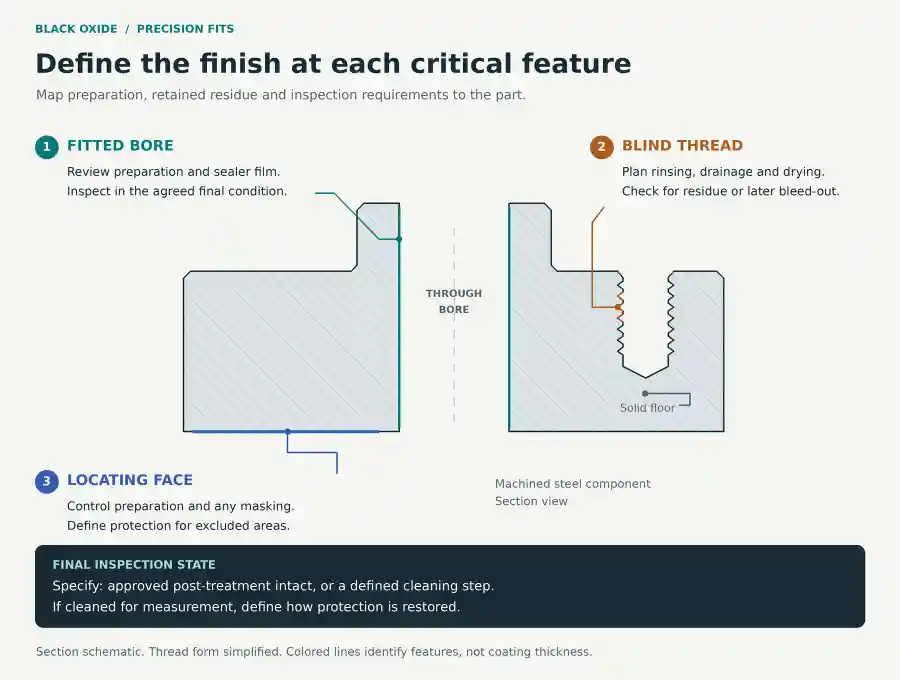
Dry-to-touch products can leave waxy or polymer films. Film thickness and buildup in recesses depend on the product and application. Check the selected sealer against the clearance in fitted bores and threads. If masking is required, state whether it excludes the conversion treatment, the sealer, or both. Also define protection for the excluded surface.
Blind holes and deep threads can trap processing solution. The finishing plan should cover rinsing, drainage, drying, and the timing of the preservative step. Inspect these areas for deposits or later bleed-out. Their color alone does not establish the cause.
Specify whether inspection occurs with the approved post-treatment intact or after a defined cleaning step. Where a sample is cleaned for measurement, also define how its required protection will be restored.
Our CNC machining tolerances guide explains why acceptance conditions should be settled before machining.
Match the Process to the Steel and Its Condition
“Steel” is not a complete material specification for blackening.
Provide the grade, heat-treatment condition, and relevant hardness requirement. A process suitable for one carbon or alloy steel should not be assumed to suit stainless steel without a separate review.
Stainless blackening requires compatible chemistry and preparation. Its black appearance does not demonstrate the same corrosion performance as a specified passivated stainless surface.
Heat-treated parts also need attention before they enter the finishing line. Acid pickling can introduce hydrogen into steel, so cleaning and descaling methods need review for susceptible high-strength parts.
For example, MIL-DTL-13924F, Sections 3.10 and 4.4.4, requires hydrogen-embrittlement relief after coating for steel surface- or through-hardened to 39 HRC or above. This treatment follows the final water rinse and comes before the supplementary preservative. The baking cycle must follow the applicable specification and contract; one temperature and holding time should not be applied to every hardened steel part.
Stress relief before coating and hydrogen-embrittlement relief after coating serve different purposes. Check which requirements apply to the complete process.
For parts made from common alloy steels, our 4130 vs 4140 steel comparison explains why grade and heat treatment need to be considered together.
Specify the Finish Beyond Its Color
Where the contract requires it, identify the applicable revision and class of MIL-DTL-13924 or another agreed finish specification. The scope of MIL-DTL-13924 itself describes limited protection in mildly corrosive conditions; it does not make every black part suitable for severe corrosion exposure.
A useful finish note should settle the following points:
- Process: The required coating specification or approved blackening route, including whether alternatives need approval.
- Post-treatment: The selected oil, wax, or sealer and any residue or compatibility requirements.
- Coverage: Surfaces to be coated, excluded areas, and permissible handling or contact marks.
- Final condition: Which dimensions and surface requirements apply after finishing, and how parts are prepared for inspection.
- Downstream cleaning: Any wash, solvent wipe, bonding preparation, or lubrication step that will follow.
- Protection and acceptance: Packaging requirements and the agreed checks for appearance, finish quality, and corrosion performance.
Avoid combining “remove all oil before shipment” with a corrosion requirement validated only on the oiled finish. Either qualify the cleaned condition or agree on a different protective system.
The drawing and purchase order should describe the same finish. A correct coating process followed by the wrong sealer can still produce an unsuitable part.
Check Appearance, Fit, and Protection Separately
A uniformly black surface is useful visual evidence, but it does not answer every acceptance question.
Appearance: Compare color, gloss, visible marks, and allowed contact areas against agreed criteria. Use consistent lighting. An approved appearance sample helps define expectations, but it cannot prove the chemistry or corrosion performance.
Finish quality: Use the checks required by the agreed process or specification. Look for loose residue and examine recesses where rinsing and drying may be difficult. Define any wipe or rub test instead of inventing a shop-floor pass/fail rule.
Dimensions and assembly: Inspect identified fits after finishing in the agreed condition. Include any threads, bearing seats, or sliding features whose function could be affected by preparation or retained film.
Protection: Verify the specified post-treatment and packaging. Where corrosion testing is required, the test pieces and their condition must represent the approved system.
If rust appears after washing, record the cleaning agent, sequence, drying method, and storage exposure. Compare these with the original acceptance condition. Removed preservative is one possible explanation; incomplete cleaning, retained residue, or another process issue may also need investigation.
The oxide layer itself is not a substitute for a wear-resistant coating or a specified lubricant. A dark sliding surface still needs a suitable material, contact design, and lubrication plan.
Send the Cleaning Requirement With the Drawing
For a blackened shaft, fixture component, threaded part, or close-fitting mechanism, include more than a color request.
Send the steel grade and condition, marked fits, required finish specification, permitted oil or sealer, cleaning sequence, and expected exposure. If the part must arrive dry or be degreased before assembly, state that at the start.
Use our precision machining services page to request a review of the machining and finishing requirements together. Include how the part will be cleaned and used, so the review can address retained protection and final fit before the process is approved.